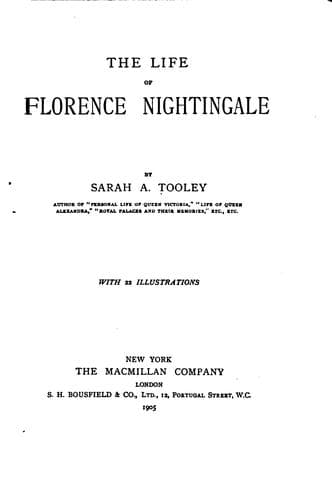
Nightingale, Florence, 1820-1910; Nurses -- England -- Biography
Her services and advice were not only highly valued by Lord Herbert,
but were acknowledged by the first statesmen of the day. In the
tributes paid to the memory of Lord Herbert at the time of his death,
the name of Florence Nightingale was coupled with his in the work of
army reform.
At a meeting held in Willis’s Rooms on November 28th, 1861, to
consider the erection of a memorial in London to Lord Herbert of Lea,
Lord Palmerston, then Prime Minister, speaking of the work in army
reform accomplished by Lord Herbert, with the assistance of the Duke
of Cambridge, Commander-in-Chief, said: “There were not only two;
there was a third engaged in these honourable exertions, and Miss
Nightingale, though a volunteer in the service, acted with all the zeal
of a volunteer and was greatly assistant.”
Mr. Gladstone, then Chancellor of the Exchequer, followed with
a similar appreciation. Referring to the above remarks of Lord
Palmerston, he said: “My noble friend who moved the first resolution
directed attention to one name in particular that ought never to be
mentioned with any elaborate attempt at eulogy; for the name of Miss
Nightingale by its own unaided power becomes a talisman to all her
fellow-countrymen.”
Mr. Gladstone then proceeded to summarise the work of Lord Herbert in
which our heroine had so signally helped. “To him we owe the Commission
for Inquiry into Barracks and Hospitals, to him we are indebted for the
reorganisation of the Medical Department of the Army. To him we owe the
Commission of Inquiry into and remodelling the medical education of the
army. And lastly we owe him the Commission for presenting to the public
the vital statistics of the army in such a form, from time to time,
that the great and living facts of the subjects are brought to view.”
Such was the perfect knight, the gallant gentleman, and the high-souled
reformer whose loss Florence Nightingale now deplored. From her
sick-room she followed with interest the schemes to honour his memory.
It was proposed to erect his statue outside the War Office in Pall
Mall, and to endow an exhibition of gold medals in connection with
the Army Medical School at Chatham, which had been founded under his
auspices. At Salisbury, the city where the names of Lord and Lady
Herbert were household words as benefactors to the sick and distressed,
a public meeting was held to promote a fund for erecting a bronze
statue to Lord Herbert and for the support of a Convalescent Hospital
at Charmouth as a branch of the Salisbury Hospital, to which he had
been such a liberal benefactor.
Public-domain text, read in full here on John Shaqi.
Reviews
Reviews
No reviews yet
Be the first to share your thoughts on this work.
Elsewhere in the archive
Join the Discussion
Join the discussion
Sign in to leave a comment or review.
Sign InorCreate an account