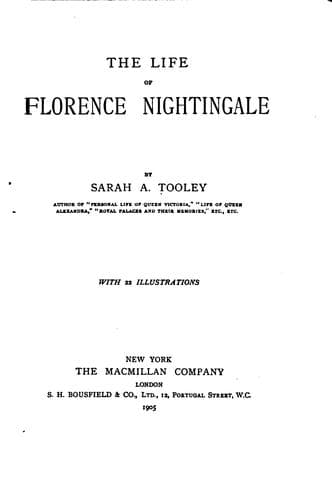
Nightingale, Florence, 1820-1910; Nurses -- England -- Biography
She goes on to tell of the good results taking place from the
introduction of gymnastics for the men and cricket and other outdoor
sports. “In short,” she adds in a pithy sentence, “work and all
kinds of exercise cause sickly men to flourish.” Soldiers’ libraries
were being established by Government, better cook-houses built, and
the soldiers taught to cook. And so far she is glad to record that
the soldiers’ habits had improved. “But the main causes of diseases
in India--want of drainage, want of water supply for stations and
towns--remain as before,” she ironically remarks, “in all their
primitive perfection.” The death-rate of troops serving in India was
the alarming one of sixty-nine per thousand per annum. “It takes
something more than climate to account for this,” she writes. “All that
the climate requires is that men shall adapt their social habits and
customs to it, as, indeed, they must do to the requirements of every
other climate under heaven. There is not a shadow of proof that India
was created to be the grave of the British race.”
Miss Nightingale then enumerates the simple rules for dress, diet,
and exercise to be observed by soldiers serving in India. But though
a man can regulate his personal habits, “he cannot,” she adds, “drain
and sewer his own city, nor lay a water supply on to his own station,
nor build his own barracks,” and she proceeds to urge that sanitary
reform in India is still one of the most pressing questions for the
Government. By wise measures the enormous death-rate of sixty-nine per
thousand might be reduced to ten per thousand. “What a work, what a
noble task for a Government--no ‘inglorious period of our dominion’
that,” she writes, “but a most glorious one!”
Ten years later Miss Nightingale again returned to the “charge” and
prepared a paper on “Life or Death in India,” which was read at the
meeting of the National Association for the promotion of Social Science
at Norwich in 1873, and afterwards published as a pamphlet with an
appendix on “Life or Death by Irrigation.”
In this paper Miss Nightingale pointed out the cheering fact that
during the past ten years in which sanitary reforms had been
progressing the death-rate of the army in India had been reduced from
sixty-nine per thousand to eighteen per thousand--that is, eighteen
men died where sixty-nine had died before. Still, she considered
that this only sufficed to show the work that yet remained to be
done, especially with regard to the drainage, water supply, and the
irrigation of the country for commercial purposes, on account not only
of the soldier, but to promote the health of the teeming millions of
our fellow-subjects in India and their general prosperity.
Public-domain text, read in full here on John Shaqi.
Reviews
Reviews
No reviews yet
Be the first to share your thoughts on this work.
Elsewhere in the archive
Join the Discussion
Join the discussion
Sign in to leave a comment or review.
Sign InorCreate an account