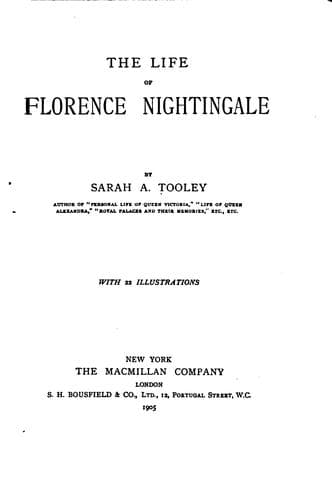
Nightingale, Florence, 1820-1910; Nurses -- England -- Biography
Happily Miss Nightingale’s work was not done yet. Two years later
(1892) found her at the age of seventy-two starting a vigorous health
crusade in Buckinghamshire in particular, and in the rural districts
generally. The 1890 Act for the Better Housing of the Working Classes
specially roused her attention in a subject in which she had always
been interested. She had little faith in Acts of Parliament reforming
the habits of the people. “On paper,” she writes, “there could not be a
more perfect Health Directory [than the Act] for making our _sanitary_
authorities and districts worthy of the name they bear. We have powers
and definitions. Everything is provided except the two most necessary:
the money to pay for and the will to carry out the reforms.” If the new
Act were enforced, Miss Nightingale was of opinion that three-fourths
of the rural districts in England would be depopulated and “we should
have hundreds and thousands of poor upon our hands, owing to the large
proportion of houses unfit for habitation in the rural districts.”
In 1892 Miss Nightingale addressed a stirring letter to the
Buckinghamshire County Council on the advisability of appointing a
Sanitary Committee to deal with the health questions of the district.
“We must create a public opinion which will drive the Government,” she
wrote, “instead of the Government having to drive us--an enlightened
public opinion, wise in principles, wise in details. We hail the County
Council as being or becoming one of the strongest engines in our
favour, at once fathering and obeying the great impulse for national
health against national and local disease. For we have learned that
we have national health in our hands--local sanitation, national
health. But we have to contend against centuries of superstition and
generations of indifference. Let the County Council take the lead.”
Miss Nightingale believed that the best method for promoting sanitary
reform among the people was to influence the women--the wives and
mothers who had control of the domestic management of the homes. Her
next step was, with the aid of the County Council Technical Instruction
Committee, to arrange for a missioner to teach in the rural districts
of Buckinghamshire. She selected three specially trained and educated
women, who were not only to give addresses in village schoolrooms
on such matters as disinfection, personal cleanliness, ventilation,
drainage, whitewashing, but were to visit the homes of the poor and
give friendly instruction and advice to the women.
She knew, and respected the feeling, that an Englishman regards
his home, however humble, as a castle into which no one may enter
uninvited. Miss Nightingale had no sympathy with the class of “visiting
ladies” who lift the latch of a poor person’s cottage and walk in
without knocking. In launching her scheme of visitation she did the
courteous thing by writing a circular letter to the village mothers,
asking them to receive the missioners. The letter runs:--
Public-domain text, read in full here on John Shaqi.
Reviews
Reviews
No reviews yet
Be the first to share your thoughts on this work.
Elsewhere in the archive
Join the Discussion
Join the discussion
Sign in to leave a comment or review.
Sign InorCreate an account