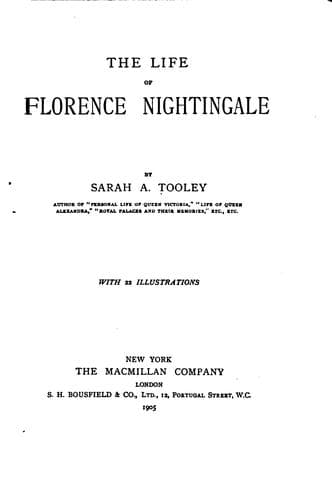
Nightingale, Florence, 1820-1910; Nurses -- England -- Biography
In addition to an independent medical officer and sanitary inspector
under him, “we want,” said Miss Nightingale, “a fully trained nurse
for every district and a health missioner,” and she defines her idea
of the duties of a missioner. These women must of course be highly
qualified for their work. They should visit the homes of the people to
advocate rules of health. Persuade the careful housewife, who is afraid
of dirt falling on to her clean grate, to remove the sack stuffed up
the unused chimney, teach the cottagers to open their windows in the
most effective way for free ventilation. “It is far more difficult
to get people to avoid poisoned air than poisoned water,” says Miss
Nightingale, “for they drink in poisoned air all night in their
bedrooms.” The mothers should be taught the value of a daily bath, the
way to select nourishing food for their families, what to do till the
doctor comes and after he has left.
However, the first great step for the missioner is to get the trust
and friendship of the women. And this “is not made by lecturing upon
bedrooms, sculleries, sties, and wells in general, but by examination
of particular rooms, etc.” The missioner, above all, must not appear to
“pry” into the homes, or to talk down to the women, neither should she
give alms. The whole object of the recommendations was to teach people
how to avoid sickness and poverty.
Miss Nightingale’s efforts to promote sanitary reforms were not
confined to our own land, but extended to far-away India, a country in
which she has, as we have already seen, taken a great interest. She had
watched the success of some of the sanitary schemes carried out by the
municipalities of large towns of India with satisfaction, but there yet
remained the vast rural population for which little was done, a very
serious matter indeed when we consider that ninety per cent. of the
two hundred and forty millions of India dwell in small rural villages.
Miss Nightingale prepared one of her “searchlight” papers on “Village
Sanitation in India,” which was read before the Tropical Section of the
eighth International Congress of Hygiene and Demography, held at Buda
Pesth in September, 1894.
In this she considers the condition of the rural provinces of India
from facts obtained by correspondence with people of authority on
the spot, and deals with the defective sewage, water supply, and the
difficulties arising from the insanitary habits of the people and
their attachment to old customs. “Still,” she pleads, “with a gentle
and affectionate people like the Hindoos much may be accomplished
by personal influence. I can give a striking instance within my own
knowledge. In the Bombay Presidency there was a village which had for
long years been decimated by cholera. The Government had in vain been
trying to ‘move’ the village. ‘No,’ they said, ‘they would not go; they
had been there since the time of the Mahrattas: it was a sacred spot,
and they would not move now.’
Public-domain text, read in full here on John Shaqi.
Reviews
Reviews
No reviews yet
Be the first to share your thoughts on this work.
Elsewhere in the archive
Join the Discussion
Join the discussion
Sign in to leave a comment or review.
Sign InorCreate an account