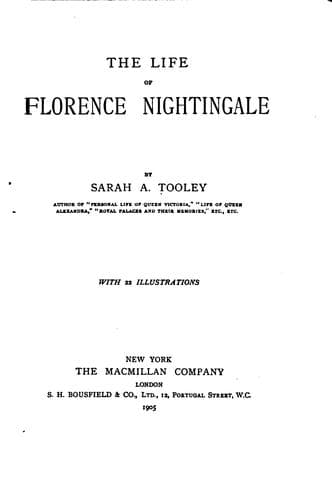
Nightingale, Florence, 1820-1910; Nurses -- England -- Biography
Nursing in a hospital which received soldiers straight from the
battlefield, their wounds aggravated by days of neglect, was a
difficult task under the most favourable circumstances, but when
intensified by the lack even of proper food, such as the above letter
discloses, the task was indeed formidable.
There was an organising brain, however, at work in that dreadful
Barrack Hospital now, and _within ten days_ of her arrival, in spite
of the terrible influx of patients which taxed her powers to the
utmost, Miss Nightingale had fitted up an impromptu kitchen, from
which eight hundred men were daily supplied with well-cooked food and
other comforts. It was largely supplied with the invalid food from the
private stores of the Lady-in-Chief, which fortunately she had brought
out with her in the _Vectis_. Beef-tea, chicken broth, jelly, and
little delicacies unheard of before were now administered to the sick
by the gentle hands of women nurses. Small wonder that the poor fellows
could often only express their gratitude in voices half-choked with
sobs!
One Crimean veteran told the writer that when he received a basin of
arrowroot on his first arrival at the hospital early in the morning, he
said to himself, “Tommy, me boy, that’s all you’ll get into your inside
this blessed day, and think yourself lucky you’ve got that. But two
hours later, if another of them blessed angels didn’t come entreating
of me to have just a little chicken broth! Well, I took that, thinking
maybe it was early dinner, and before I had well done wondering what
would happen next, round the nurse came again with a bit o’ jelly, and
all day long at intervals they kept on bringing me what they called ‘a
little nourishment.’ In the evening, Miss Nightingale she came and had
a look at me, and says she, ‘I hope you’re feeling better.’ I could
have said, ‘Ma’am, I feels as fit as a fightin’ cock,’ but I managed to
git out somethin’ a bit more polite.”
Hitherto, not only had there been a lack of food, but the cooking had
been done by the soldiers themselves in the most free and easy manner.
Meat and vegetables were boiled together in the huge coppers, of which
there were thirteen in the kitchen attached to the barracks. Separate
portions were enclosed in nets, and all plunged together into the
seething coppers, and taken up when occasion demanded. Some things were
served up done to rags, while others were almost raw. This kind of
cooking was bad enough for men in ordinary health, but for the sick it
meant death.
Public-domain text, read in full here on John Shaqi.
Reviews
Reviews
No reviews yet
Be the first to share your thoughts on this work.
Elsewhere in the archive
Join the Discussion
Join the discussion
Sign in to leave a comment or review.
Sign InorCreate an account