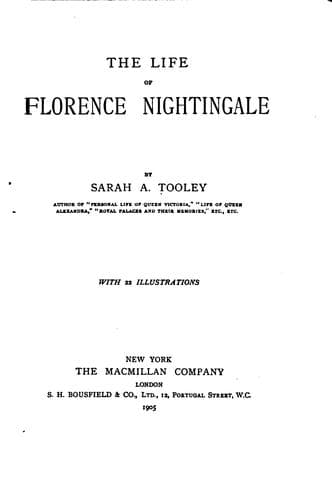
Nightingale, Florence, 1820-1910; Nurses -- England -- Biography
The “Merry Christmas” passed from man to man was not a misnomer,
despite the pain and suffering; the men were at least “merry” that the
“nightingales” had come. When the Queen’s health was drunk, in some
cases from medicine glasses, each man in his heart coupled with the
loyal toast the names of the Lady-in-Chief and her devoted band.
CHAPTER XIV
_GRAPPLING WITH CHOLERA AND FEVER_
Florence Nightingale describes the Hardships of the Soldiers--Arrival
of Fifty More Nurses--Memories of Sister Mary Aloysius--The
Cholera Scourge.
So in that house of misery,
A lady with a lamp I see
Pass through the glimmering gloom,
And flit from room to room.
LONGFELLOW.
The New Year of 1855 brought no mitigation in Florence Nightingale’s
arduous task. Though there was no longer the influx of wounded from the
battlefields, disease was making fearful ravages amongst the soldiers
now engaged in the prolonged siege of Sebastopol. Miss Nightingale thus
described the hardships endured by the men in a letter to a friend.
“Fancy,” she writes, “working five nights out of seven in the trenches!
Fancy being thirty-six hours in them at a stretch, as they were all
December, lying down, or half lying down, after forty-eight hours, with
no food but raw salt pork sprinkled with sugar, rum, and biscuit;
nothing hot, because the exhausted soldier could not collect his own
fuel, as he was expected to do, to cook his own rations; and fancy
through all this the army preserving their courage and patience as they
have done. There is something sublime in the spectacle.”
The result of this life of exposure in the trenches during the rigours
of the Crimean winter was terrible suffering amongst the soldiers from
frost-bite and dysentery, and there was a great increase in cholera and
fever, which kept the hospitals more crowded than ever.
At the beginning of the year a further staff of fifty trained nurses
under Miss Stanley, the sister of the late Dean, arrived at Scutari
and were distributed amongst the various hospitals in the East.
Miss Nightingale had now five thousand sick and wounded under her
supervision, and eleven hundred more were on their way from the
Crimea. Under her immediate personal care in the Barrack Hospital were
more than two thousand wounded, all severe cases. She had also now
established her _régime_ in the General Hospital at Scutari, and some
of the new nurses were installed there under Miss Emily Anderson, while
others went to Kullali Hospital on the other side of the Bosphorus and
worked under Miss Stanley until she returned to England.
Sisters of mercy from some of the Irish convents were among the new
nurses, and one of the number, Sister Mary Aloysius, is still at the
time of writing living in her convent home at Gort, Co. Galway. Her
“Memories” of the Crimea afford a graphic picture of the state of the
General Hospital at Scutari and of the arduous toil of the nurses.
Public-domain text, read in full here on John Shaqi.
Reviews
Reviews
No reviews yet
Be the first to share your thoughts on this work.
Elsewhere in the archive
Join the Discussion
Join the discussion
Sign in to leave a comment or review.
Sign InorCreate an account