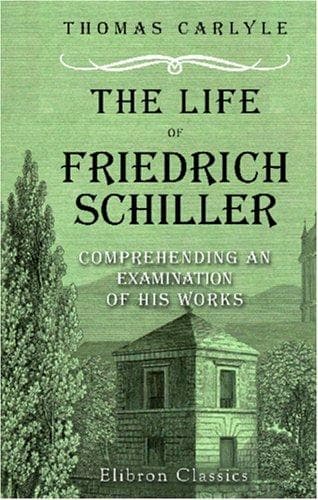
The Life of Friedrich Schiller: Comprehending an Examination of His WorksCarlyle, Thomas
General
The Life of Friedrich Schiller: Comprehending an Examination of His Works
Carlyle, Thomas
Authors, German -- 18th century -- Biography; Schiller, Friedrich, 1759-1805; Schubart, Christian Friedrich Daniel, 1739-1791
The coöperation of Goethe, which Schiller had obtained so readily in
these pursuits, was of singular use to him in many others. Both
possessing minds of the first order, yet constructed and trained in
the most opposite modes, each had much that was valuable to learn of
the other, and suggest to him. Cultivating different kinds of
excellence, they could joyfully admit each other's merit; connected by
mutual services, and now by community of literary interests, few
unkindly feelings could have place between them. For a man of high
equalities, it is rare to find a meet companion; painful and injurious
to want one. Solitude exasperates or deadens the heart, perverts or
enervates the faculties; association with inferiors leads to dogmatism
in thought, and self-will even in affections. Rousseau never should
have lived in the Val de Montmorenci; it had been good for Warburton
that Hurd had not existed; for Johnson never to have known Boswell or
Davies. From such evils Schiller and Goethe were delivered; their
intimacy seems to have been equal, frank and cordial; from the
contrasts and the endowments of their minds, it must have had peculiar
charms. In his critical theories, Schiller had derived much profit
from communicating with an intellect as excursive as his own, but far
cooler and more sceptical: as he lopped off from his creed the
excrescences of Kantism, Goethe and he, on comparing their ideas,
often found in them a striking similarity; more striking and more
gratifying, when it was considered from what diverse premises these
harmonious conclusions had been drawn. On such subjects they often
corresponded when absent, and conversed when together. They were in
the habit of paying long visits to each other's houses; frequently
they used to travel in company between Jena and Weimar. 'At Triesnitz,
a couple of English miles from Jena, Goethe and he,' we are told,
'might sometimes be observed sitting at table, beneath the shade of a
spreading tree; talking, and looking at the current of passengers.'—There
are some who would have 'travelled fifty miles on foot' to join the
party!
Public-domain text, read in full here on John Shaqi.
Reviews
Reviews
No reviews yet
Be the first to share your thoughts on this work.
Elsewhere in the archive
Join the Discussion
Join the discussion
Sign in to leave a comment or review.
Sign InorCreate an account