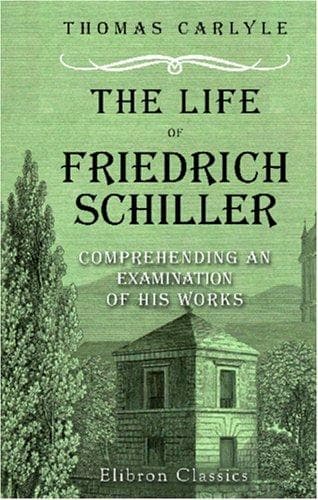
The Life of Friedrich Schiller: Comprehending an Examination of His WorksCarlyle, Thomas
General
The Life of Friedrich Schiller: Comprehending an Examination of His Works
Carlyle, Thomas
Authors, German -- 18th century -- Biography; Schiller, Friedrich, 1759-1805; Schubart, Christian Friedrich Daniel, 1739-1791
'This sword of ours is no plough or spade,
You cannot delve or reap with the iron blade;
For us there falls no seed, no corn-field grows,
Neither home nor kindred the soldier knows:
Wandering over the face of the earth,
Warming his hands at another's hearth:
From the pomp of towns he must onward roam;
In the village-green with its cheerful game,
In the mirth of the vintage or harvest-home,
No part or lot can the soldier claim.
Tell me then, in the place of goods or pelf,
What has he unless to honour himself?
Leave not even _this_ his own, what wonder
The man should burn and kill and plunder?
But the camp of Wallenstein is fall of bustle as well as speculation;
there are gamblers, peasants, sutlers, soldiers, recruits, capuchin
friars, moving to and fro in restless pursuit of their several
purposes. The sermon of the Capuchin is an unparalleled
composition;[34] a medley of texts, puns, nicknames, and verbal logic,
conglutinated by a stupid judgment, and a fiery catholic zeal. It
seems to be delivered with great unction, and to find fit audience in
the camp: towards the conclusion they rush upon him, and he narrowly
escapes killing or ducking, for having ventured to glance a censure at
the General. The soldiers themselves are jeering, wrangling, jostling;
discussing their wishes and expectations; and, at last, they combine
in a profound deliberation on the state of their affairs. A vague
exaggerated outline of the coming events and personages is imaged to
us in their coarse conceptions. We dimly discover the precarious
position of Wallenstein; the plots which threaten him, which he is
meditating: we trace the leading qualities of the principal officers;
and form a high estimate of the potent spirit which, binds this fierce
discordant mass together, and seems to be the object of universal
reverence where nothing else is revered.
[Footnote 34: Said to be by Goethe; the materials faithfully
extracted from a real sermon (by the Jesuit Santa Clara) of
the period it refers to.—There were various Jesuits Santa
Clara, of that period: this is the _German_ one, Abraham by
name; specimens of whose Sermons, a fervent kind of
preaching-run-mad, have been reprinted in late years, for
dilettante purposes, (_Note of 1845._)]
Public-domain text, read in full here on John Shaqi.
Reviews
Reviews
No reviews yet
Be the first to share your thoughts on this work.
Elsewhere in the archive
Join the Discussion
Join the discussion
Sign in to leave a comment or review.
Sign InorCreate an account