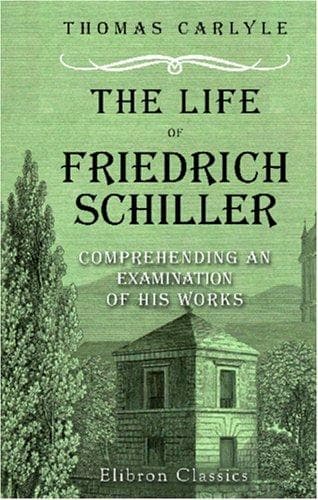
The Life of Friedrich Schiller: Comprehending an Examination of His WorksCarlyle, Thomas
General
The Life of Friedrich Schiller: Comprehending an Examination of His Works
Carlyle, Thomas
Authors, German -- 18th century -- Biography; Schiller, Friedrich, 1759-1805; Schubart, Christian Friedrich Daniel, 1739-1791
But among the tumults of this busy multitude, there are two forms of
celestial beauty that solicit our attention, and whose destiny,
involved with that of those around them, gives it an importance in our
eyes which it could not otherwise have had. Max Piccolomini, Octavio's
son, and Thekla, the daughter of Wallenstein, diffuse an ethereal
radiance over all this tragedy; they call forth the finest feelings of
the heart, where other feelings had already been aroused; they
superadd to the stirring pomp of scenes, which had already kindled
our imaginations, the enthusiasm of bright unworn humanity, 'the bloom
of young desire, the purple light of love.' The history of Max and
Thekla is not a rare one in poetry; but Schiller has treated it with a
skill which is extremely rare. Both of them are represented as
combining every excellence; their affection is instantaneous and
unbounded; yet the coolest, most sceptical reader is forced to admire
them, and believe in them.
Of Max we are taught from the first to form the highest expectations:
the common soldiers and their captains speak of him as of a perfect
hero; the Cuirassiers had, at Pappenheim's death, on the field of
Lützen, appointed him their colonel by unanimous election. His
appearance answers these ideas: Max is the very spirit of honour, and
integrity, and young ardour, personified. Though but passing into
maturer age, he has already seen and suffered much; but the experience
of the man has not yet deadened or dulled the enthusiasm of the boy.
He has lived, since his very childhood, constantly amid the clang of
war, and with few ideas but those of camps; yet here, by a native
instinct, his heart has attracted to it all that was noble and
graceful in the trade of arms, rejecting all that was repulsive or
ferocious. He loves Wallenstein his patron, his gallant and majestic
leader: he loves his present way of life, because it is one of peril
and excitement, because he knows no other, but chiefly because his
young unsullied spirit can shed a resplendent beauty over even the
wastest region in the destiny of man. Yet though a soldier, and the
bravest of soldiers, he is not this alone. He feels that there are
fairer scenes in life, which these scenes of havoc and distress but
deform or destroy; his first acquaintance with the Princess Thekla
unveils to him another world, which till then he had not dreamed of; a
land of peace and serene elysian felicity, the charms of which he
paints with simple and unrivalled eloquence. Max is not more daring
than affectionate; he is merciful and gentle, though his training has
been under tents; modest and altogether unpretending, though young and
universally admired. We conceive his aspect to be thoughtful but
fervid, dauntless but mild: he is the very poetry of war, the essence
of a youthful hero. We should have loved him anywhere; but here, amid
barren scenes of strife and danger, he is doubly dear to us.
Public-domain text, read in full here on John Shaqi.
Reviews
Reviews
No reviews yet
Be the first to share your thoughts on this work.
Elsewhere in the archive
Join the Discussion
Join the discussion
Sign in to leave a comment or review.
Sign InorCreate an account