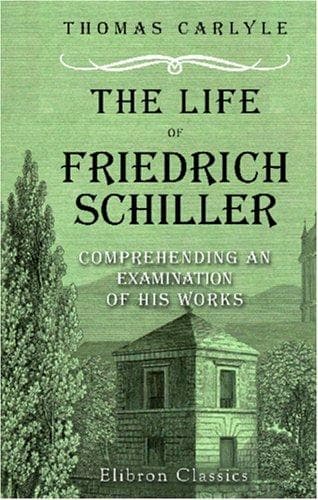
The Life of Friedrich Schiller: Comprehending an Examination of His WorksCarlyle, Thomas
General
The Life of Friedrich Schiller: Comprehending an Examination of His Works
Carlyle, Thomas
Authors, German -- 18th century -- Biography; Schiller, Friedrich, 1759-1805; Schubart, Christian Friedrich Daniel, 1739-1791
MAX. And who's to blame for it but you at Court?
I will deal plainly with you, Questenberg:
When I observ'd you here, a twinge of spleen
And bitterness went through me. It is you
That hinder peace; yes, you. The General
Must force it, and you ever keep tormenting him,
Obstructing all his steps, abusing him;
For what? Because the good of Europe lies
Nearer his heart, than whether certain acres
More or less of dirty land be Austria's!
You call him traitor, rebel, God knows what,
Because he spares the Saxons; as if that
Were not the only way to peace; for how
If during war, war end not, _can_ peace follow?
Go to! go to! As I love goodness, so I hate
This paltry work of yours: and here I vow to God,
For him, this rebel, traitor Wallenstein,
To shed my blood, my heart's blood, drop by drop,
Ere I will see you triumph in his fall!
The Princess Thekla is perhaps still dearer to us. Thekla, just
entering on life, with 'timid steps,' with the brilliant visions of a
cloister yet undisturbed by the contradictions of reality, beholds in
Max, not merely her protector and escort to her father's camp, but the
living emblem of her shapeless yet glowing dreams. She knows not
deception, she trusts and is trusted: their spirits meet and mingle,
and 'clasp each other firmly and forever.' All this is described by
the poet with a quiet inspiration, which finds its way into our
deepest sympathies. Such beautiful simplicity is irresistible. 'How
long,' the Countess Terzky asks,
How long is it since you disclosed your heart?
MAX. This morning first I risked a word of it.
COUN. Not till this morning during twenty days?
MAX. 'Twas at the castle where you met us, 'twixt this
And Nepomuk, the last stage of the journey.
On a balcony she and I were standing, our looks
In silence turn'd upon the vacant landscape;
And before us the dragoons were riding,
Whom the Duke had sent to be her escort.
Heavy on my heart lay thoughts of parting,
And with a faltering voice at last I said:
All this reminds me, Fräulein, that today
I must be parted from my happiness;
In few hours you will find a father,
Will see yourself encircled by new friends;
And I shall be to you nought but a stranger,
Forgotten in the crowd—"Speak with Aunt Terzky!"
Quick she interrupted me; I noticed
A quiv'ring in her voice; a glowing blush
Spread o'er her cheeks; slow rising from the ground,
Her eyes met mine: I could control myself
No longer—
[_The Princess appears at the door, and stops; the Countess, but not
Piccolomini, observing her._
—I clasp'd her wildly in my arms,
My lips were join'd with hers. Some footsteps stirring
I' th' next room parted us; 'twas you; what then
Took place, you know.
COUN. And can you be so modest,
Or incurious, as not once to ask me
For _my_ secret, in return?
MAX. Your secret?
COUN. Yes, sure! On coming in the moment after,
How my niece receiv'd me, what i' th' instant
Of her first surprise she—
Public-domain text, read in full here on John Shaqi.
Reviews
Reviews
No reviews yet
Be the first to share your thoughts on this work.
Elsewhere in the archive
Join the Discussion
Join the discussion
Sign in to leave a comment or review.
Sign InorCreate an account