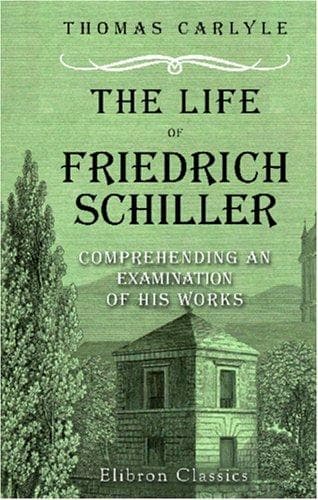
The Life of Friedrich Schiller: Comprehending an Examination of His WorksCarlyle, Thomas
General
The Life of Friedrich Schiller: Comprehending an Examination of His Works
Carlyle, Thomas
Authors, German -- 18th century -- Biography; Schiller, Friedrich, 1759-1805; Schubart, Christian Friedrich Daniel, 1739-1791
The official services expected of him in return for so much kindness
seem to have been slight, if any. Chiefly or altogether of his own
accord, he appears to have applied himself to a close inspection of
the theatre, and to have shared with Goethe the task of superintending
its concerns. The rehearsals of new pieces commonly took place at the
house of one of these friends; they consulted together on all such
subjects, frankly and copiously. Schiller was not slow to profit by
the means of improvement thus afforded him; in the mechanical details
of his art he grew more skilful: by a constant observation of the
stage, he became more acquainted with its capabilities and its laws.
It was not long till, with his characteristic expansiveness of
enterprise, he set about turning this new knowledge to account. In
conjunction with Goethe, he remodelled his own _Don Carlos_ and his
friend's _Count Egmont_, altering both according to his latest views
of scenic propriety. It was farther intended to treat, in the same
manner, the whole series of leading German plays, and thus to produce
a national stock of dramatic pieces, formed according to the best
rules; a vast project, in which some progress continued to be made,
though other labours often interrupted it. For the present, Schiller
was engaged with his _Maria Stuart_: it appeared in 1800.
This tragedy will not detain us long. It is upon a subject, the
incidents of which are now getting trite, and the moral of which has
little that can peculiarly recommend it. To exhibit the repentance of
a lovely but erring woman, to show us how her soul may be restored to
its primitive nobleness, by sufferings, devotion and death, is the
object of _Maria Stuart_. It is a tragedy of sombre and mournful
feelings; with an air of melancholy and obstruction pervading it; a
looking backward on objects of remorse, around on imprisonment, and
forward on the grave. Its object is undoubtedly attained. We are
forced to pardon and to love the heroine; she is beautiful, and
miserable, and lofty-minded; and her crimes, however dark, have been
expiated by long years of weeping and woe. Considering also that they
were the fruit not of calculation, but of passion acting on a heart
not dead, though blinded for a time, to their enormity, they seem less
hateful than the cold premeditated villany of which she is the victim.
Elizabeth is selfish, heartless, envious; she violates no law, but she
has no virtue, and she lives triumphant: her arid, artificial
character serves by contrast to heighten our sympathy with her
warm-hearted, forlorn, ill-fated rival. These two Queens, particularly
Mary, are well delineated: their respective qualities are vividly
brought out, and the feelings they were meant to excite arise within
us. There is also Mortimer, a fierce, impetuous, impassioned lover;
driven onward chiefly by the heat of his blood, but still interesting
by his vehemence and unbounded daring. The dialogue, moreover, has
Public-domain text, read in full here on John Shaqi.
Reviews
Reviews
No reviews yet
Be the first to share your thoughts on this work.
Elsewhere in the archive
Join the Discussion
Join the discussion
Sign in to leave a comment or review.
Sign InorCreate an account