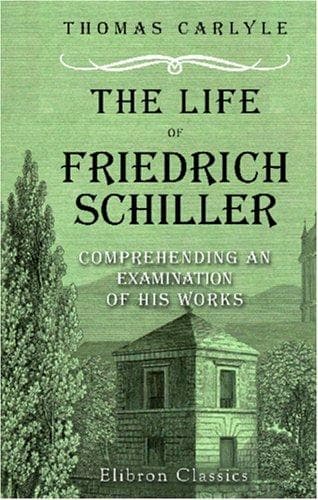
The Life of Friedrich Schiller: Comprehending an Examination of His WorksCarlyle, Thomas
General
The Life of Friedrich Schiller: Comprehending an Examination of His Works
Carlyle, Thomas
Authors, German -- 18th century -- Biography; Schiller, Friedrich, 1759-1805; Schubart, Christian Friedrich Daniel, 1739-1791
'According to his own directions, the bier was to be borne by private
burghers of the city; but several young artists and students, out of
reverence for the deceased, took it from them. It was between midnight
and one in the morning, when they approached the churchyard. The
overclouded heaven threatened rain. But as the bier was set down
beside the grave, the clouds suddenly split asunder, and the moon,
coming forth in peaceful clearness, threw her first rays on the coffin
of the Departed. They lowered him into the grave; and the moon again
retired behind her clouds. A fierce tempest of wind began to howl, as
if it were reminding the bystanders of their great, irreparable loss.
At this moment who could have applied without emotion the poet's own
words:
Alas, the ruddy morning tinges
A silent, cold, sepulchral stone;
And evening throws her crimson fringes
But round his slumber dark and lone!'
So lived and so died Friedrich Schiller; a man on whose history other
men will long dwell with a mingled feeling of reverence and love. Our
humble record of his life and writings is drawing to an end: yet we
still linger, loth to part with a spirit so dear to us. From the
scanty and too much neglected field of his biography, a few slight
facts and indications may still be gleaned; slight, but distinctive of
him as an individual, and not to be despised in a penury so great and
so unmerited.
Schiller's age was forty-five years and a few months when he died.[38]
Sickness had long wasted his form, which at no time could boast of
faultless symmetry. He was tall and strongly boned; but unmuscular and
lean: his body, it might be perceived, was wasting under the energy of
a spirit too keen for it. His face was pale, the cheeks and temples
rather hollow, the chin somewhat deep and slightly projecting, the
nose irregularly aquiline, his hair inclined to auburn. Withal his
countenance was attractive, and had a certain manly beauty. The lips
were curved together in a line, expressing delicate and honest
sensibility; a silent enthusiasm, impetuosity not unchecked by
melancholy, gleamed in his softly kindled eyes and pale cheeks, and
the brow was high and thoughtful. To judge from his portraits,
Schiller's face expressed well the features of his mind: it is
mildness tempering strength; fiery ardour shining through the clouds
of suffering and disappointment, deep but patiently endured. Pale was
its proper tint; the cheeks and temples were best hollow. There are
few faces that affect us more than Schiller's; it is at once meek,
tender, unpretending, and heroic.
[Footnote 38: 'He left a widow, two sons, and two daughters,'
of whom we regret to say that we have learned nothing. 'Of
his three sisters, the youngest died before him; the eldest
is married to the Hofrath Reinwald, in Meinungen; the second
to Herr Frankh, the clergyman of Meckmuhl, in Würtemberg.'
_Doering._]
Public-domain text, read in full here on John Shaqi.
Reviews
Reviews
No reviews yet
Be the first to share your thoughts on this work.
Elsewhere in the archive
Join the Discussion
Join the discussion
Sign in to leave a comment or review.
Sign InorCreate an account