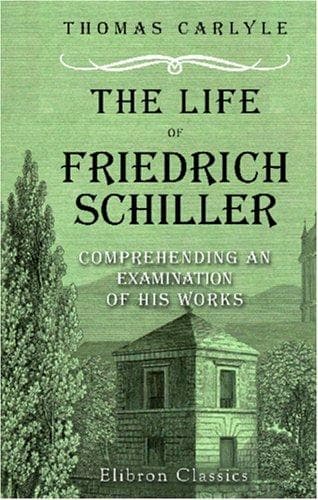
The Life of Friedrich Schiller: Comprehending an Examination of His WorksCarlyle, Thomas
General
The Life of Friedrich Schiller: Comprehending an Examination of His Works
Carlyle, Thomas
Authors, German -- 18th century -- Biography; Schiller, Friedrich, 1759-1805; Schubart, Christian Friedrich Daniel, 1739-1791
'In the year 1765, the reigning Duke, Karl of Würtemberg, sent Captain
Schiller as Recruiting Officer to the Imperial Free-Town
Schwäbish-Gmünd; with permission to live with his Family in the
nearest Würtemberg place, the Village and Cloister of Lorch. Lorch
lies in a green meadow-ground, surrounded by beech-woods, at the foot
of a hill, which is crowned by the weird buildings of the Cloister,
where the Hohenstaufen graves are; opposite the Cloister and Hamlet,
rise the venerable ruins of Hohenstaufen itself, with a series of
hills; at the bottom winds the Rems,' a branch of the Neckar, 'towards
still fruitfuler regions. In this attractive rural spot the Schiller
Family resided for several years; and found from the pious and kindly
people of the Hamlet, and especially from a friend of the house,
Moser, the worthy Parish-Parson there, the kindliest reception. The
Schiller children soon felt themselves at home and happy in Lorch,
especially Fritz did, who, in the Parson's Son, Christoph Ferdinand
Moser, a soft gentle child, met with his first boy-friend. In this
worthy Parson's house he also received, along with the Parson's own
Sons, the first regular and accurate instruction in reading and
writing, as also in the elements of Latin and Greek. This arrangement
pleased and comforted Captain Schiller not a little: for the more
distinctly he, with his clear and candid character, recognised the
insufficiency of his own instruction and stock of knowledge, the more
impressively it lay on him that his Son should early acquire a good
foundation in Languages and Science, and learn something solid and
effective. What he could himself do in that particular he faithfully
did; bringing out, with this purpose, partly the grand historical
memorials of that neighbourhood, partly his own life-experiences, in
instructive and exciting dialogues with his children. He would point
out to the listening little pair the venerable remains of the
Hohenstaufen Ancestral Castle, or tell them of his own soldier-career.
He took the Boy with him into the Exercise Camp, to the Woodmen in the
Forest, and even into the farther-distant pleasure-castle of
Hohenheim; and thereby led their youthful imagination into many
changeful imaginings of life.[46]
[Footnote 46: _Saupe_, p. 11.]
Public-domain text, read in full here on John Shaqi.
Reviews
Reviews
No reviews yet
Be the first to share your thoughts on this work.
Elsewhere in the archive
Join the Discussion
Join the discussion
Sign in to leave a comment or review.
Sign InorCreate an account