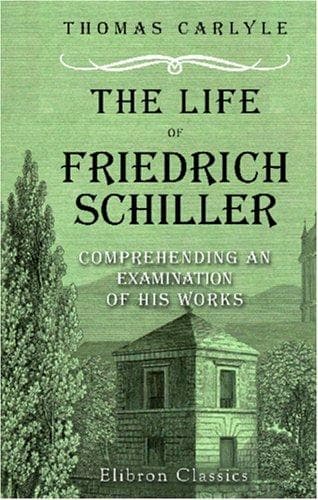
The Life of Friedrich Schiller: Comprehending an Examination of His WorksCarlyle, Thomas
General
The Life of Friedrich Schiller: Comprehending an Examination of His Works
Carlyle, Thomas
Authors, German -- 18th century -- Biography; Schiller, Friedrich, 1759-1805; Schubart, Christian Friedrich Daniel, 1739-1791
II. THE MOTHER.
Of Schiller's Mother, Elisabetha Dorothea Kodweis, born at Marbach
1733, the preliminary particulars have been given above: That she was
the daughter of an Innkeeper, Woodmeasurer and Baker; prosperous in
the place when Schiller Senior first arrived there. We should have
added, what Saupe omits, that the young Surgeon boarded in their
house; and that by the term Woodmeasurer (_Holzmesser_, Measurer of
Wood) is signified an Official Person appointed not only to measure
and divide into portions the wood supplied as fuel from the Ducal or
Royal Forests, but to be responsible also for payment of the same. In
which latter capacity, Kodweis, as Father Schiller insinuates, was
rash, imprudent and unlucky, and at one time had like to have involved
that prudent, parsimonious Son-in-law in his disastrous economics. We
have also said what Elisabetha's comely looks were, and particular
features; pleasing and hopeful, more and more, to the strict young
Surgeon, daily observant of her and them.
'In her circle,' Saupe continues, 'she was thought by her early
playmates a kind of enthusiast; because she, with average faculties of
understanding combined deep feeling, true piety and love of Nature, a
talent for Music, nay even for Poetry. But perhaps it was the very
reverse qualities in her, the fact namely that what she wanted in
culture, and it may be also in clearness and sharpness of
understanding, was so richly compensated by warmth and lovingness of
character,—perhaps it was this which most attracted to her the heart
of her deeply-reasonable Husband. And never had he cause to repent his
choice. For she was, and remained, as is unanimously testified of her
by trustworthy witnesses, an unpretending, soft and dutiful Wife; and,
as all her Letters testify, had the tenderest mother-heart. She read a
good deal, even after her marriage, little as she had of time for
reading. Favourite Books with her were those on Natural History; but
she liked best of all to study the Biographies of famous men, or to
dwell in the spiritual poetising of an Utz, a Gellert and Klopstock.
She also liked, and in some measure had the power, to express her own
feelings in verses; which, with all their simplicity, show a sense for
rhythm and some expertness in diction. Here is one instance; her
salutation to the Husband who was her First-love, on New-year's day
1757, the ninth year of their as yet childless marriage:
O could I but have found forget-me-not in the Valley,
And roses beside it! Then had I plaited thee
In fragrant blossoms the garland for this New Year,
Which is still brighter to me than that of our Marriage was.
I grumble, in truth, that the cold North now governs us,
And every flowret's bud is freezing in the cold earth!
Yet one thing does not freeze, I mean my loving heart;
Thine that is, and shares with thee its joys and sorrows.[58]
[Footnote 58:
Public-domain text, read in full here on John Shaqi.
Reviews
Reviews
No reviews yet
Be the first to share your thoughts on this work.
Elsewhere in the archive
Join the Discussion
Join the discussion
Sign in to leave a comment or review.
Sign InorCreate an account