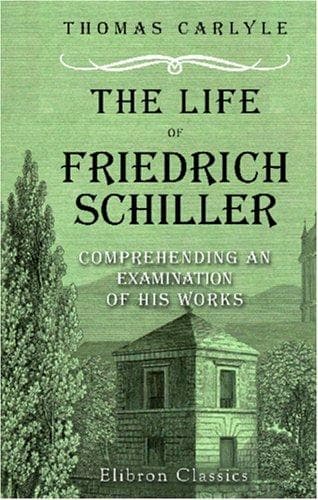
The Life of Friedrich Schiller: Comprehending an Examination of His WorksCarlyle, Thomas
General
The Life of Friedrich Schiller: Comprehending an Examination of His Works
Carlyle, Thomas
Authors, German -- 18th century -- Biography; Schiller, Friedrich, 1759-1805; Schubart, Christian Friedrich Daniel, 1739-1791
'Two years afterwards this hope passed into fulfilment. The Mother
being now completely cured of her last disorder, there seized her so
irresistible a longing for her Son, that even her hesitating Husband,
anxious lest her very health should suffer, at last gave his consent
to the far and difficult journey to Jena. On the 3d Sept. 1792,
Schiller, in joyful humour, announces to his friend in Dresden, "Today
I have received from home the very welcome tidings that my good
Mother, with one of my Sisters, is to visit us here this month. Her
arrival falls at a good time, when I hope to be free and loose from
labour; and then we have ahead of us mere joyful undertakings." The
Mother came in company with her youngest Daughter, bright little Nane,
or Nanette; and surprised him two days sooner than, by the Letters
from Solitüde, he had expected her. Unspeakable joy and sweet sorrow
seized Mother and Son to feel themselves, after ten years of
separation, once more in each other's arms. The long journey, bad
weather and roads had done her no harm. "She has altered a little, in
truth," writes he to Körner, "from what she was ten years ago; but
after so many sicknesses and sorrows, she still has a healthy look. It
rejoices me much that things have so come about, that I have her with
me again, and can be a joy to her."
'The Mother likewise soon felt herself at home and happy in the
trusted circle of her children; only too fast flew-by the beautiful
and happy days, which seemed to her richly to make amends for so many
years of sorrows and cares. Especially it did her heart good to see
for herself what a beneficent influence the real and beautiful
womanhood of her Daughter-in-law exercised upon her Son. Daily she
learnt to know the great advantages of mind and heart in her; daily
she more deeply thanked God that for her Son, who, on account even of
his weak health, was not an altogether convenient Husband, there had
been so tender-hearted and so finely-cultivated a Wife given him as
life-companion. The conviction that the domestic happiness of her Son
was secure contributed essentially also to alleviate the pain of
departure.
Public-domain text, read in full here on John Shaqi.
Reviews
Reviews
No reviews yet
Be the first to share your thoughts on this work.
Elsewhere in the archive
Join the Discussion
Join the discussion
Sign in to leave a comment or review.
Sign InorCreate an account