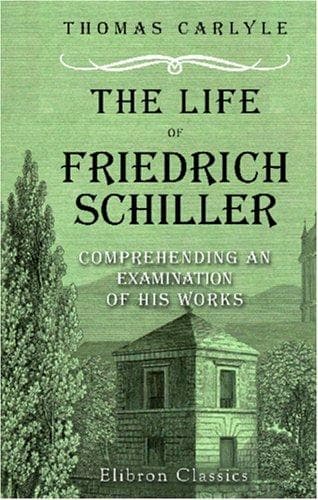
The Life of Friedrich Schiller: Comprehending an Examination of His WorksCarlyle, Thomas
General
The Life of Friedrich Schiller: Comprehending an Examination of His Works
Carlyle, Thomas
Authors, German -- 18th century -- Biography; Schiller, Friedrich, 1759-1805; Schubart, Christian Friedrich Daniel, 1739-1791
The enthusiastic discontent so manifest in the _Robbers_ has by some
been in part attributed to Schiller's intercourse with Schubart. This
seems as wise as the hypothesis of Gray's Alderman, who, after half a
century of turtle-soup, imputed the ruin of his health to eating two
unripe grapes: 'he felt them cold upon his stomach, the moment they
were over; he never got the better of them.' Schiller, it appears, saw
Schubart only once, and their conversation was not of a confidential
kind. For any influence this interview could have produced upon the
former, the latter could have merited no mention here: it is on other
grounds that we refer to him. Schubart's history, not devoid of
interest in itself, unfolds in a striking light the circumstances
under which Schiller stood at present; and may serve to justify the
violence of his alarms, which to the happy natives of our Island might
otherwise appear pusillanimous and excessive. For these reasons we
subjoin a sketch of it.
Schubart's character is not a new one in literature; nor is it strange
that his life should have been unfortunate. A warm genial spirit; a
glowing fancy, and a friendly heart; every faculty but diligence, and
every virtue but 'the understrapping virtue of discretion:' such is
frequently the constitution of the poet; the natural result of it also
has frequently been pointed out, and sufficiently bewailed. This man
was one of the many who navigate the ocean of life with 'more sail
than ballast;' his voyage contradicted every rule of seamanship, and
necessarily ended in a wreck.
Christian Friedrich Daniel Schubart was born at Obersontheim in
Swabia, on the 26th of April 1739. His father, a well-meaning soul,
officiated there in the multiple capacity of schoolmaster, precentor,
and curate; dignities which, with various mutations and improvements,
he subsequently held in several successive villages of the same
district. Daniel, from the first, was a thing of inconsistencies; his
life proceeded as if by fits and starts. At school, for a while, he
lay dormant: at the age of seven he could not read, and had acquired
the reputation of a perfect dunce. But 'all at once,' says his
biographer, 'the rind which enclosed his spirit started asunder;' and
Daniel became the prodigy of the school! His good father determined to
make a learned man of him: he sent him at the age of fourteen to the
Nordlingen Lyceum, and two years afterwards to a similar establishment
at Nürnberg. Here Schubart began to flourish with all his natural
luxuriance; read classical and domestic poets; spouted, speculated;
wrote flowing songs; discovered 'a decided turn for music,' and even
composed tunes for the harpsichord! In short, he became an
acknowledged _genius_: and his parents consented that he should go to
Jena, and perform his _cursus_ of Theology.
Public-domain text, read in full here on John Shaqi.
Reviews
Reviews
No reviews yet
Be the first to share your thoughts on this work.
Elsewhere in the archive
Join the Discussion
Join the discussion
Sign in to leave a comment or review.
Sign InorCreate an account