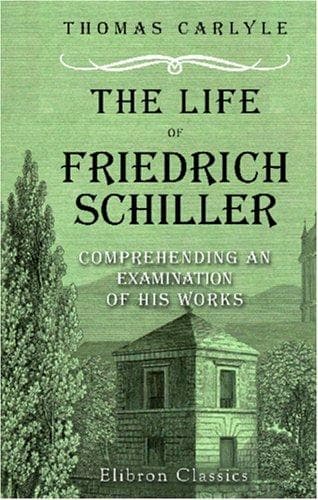
The Life of Friedrich Schiller: Comprehending an Examination of His WorksCarlyle, Thomas
General
The Life of Friedrich Schiller: Comprehending an Examination of His Works
Carlyle, Thomas
Authors, German -- 18th century -- Biography; Schiller, Friedrich, 1759-1805; Schubart, Christian Friedrich Daniel, 1739-1791
Yet withal it was impossible to hate poor Schubart, or even seriously
to dislike him. A joyful, piping, guileless mortal, good nature,
innocence of heart, and love of frolic beamed from every feature of
his countenance; he wished no ill to any son of Adam. He was musical
and poetical, a maker and a singer of sweet songs; humorous also,
speculative, discursive; his speech, though aimless and redundant,
glittered with the hues of fancy, and here and there with the keenest
rays of intellect. He was vain, but had no touch of pride; and the
excellencies which he loved in himself, he acknowledged and as warmly
loved in others. He was a man of few or no principles, but his nervous
system was very good. Amid his chosen comrades, a jug of indifferent
beer and a pipe of tobacco could change the earth into elysium for
him, and make his brethren demigods. To look at his laughing eyes, and
his effulgent honest face, you were tempted to forget that he was a
perjured priest, that the world had duties for him which he was
neglecting. Had life been all a may-game, Schubart was the best of
men, and the wisest of philosophers.
Unluckily it was not: the voice of Duty had addressed him in vain; but
that of Want was more impressive. He left his father's house, and
engaged himself as tutor in a family at Königsbronn. To teach the
young idea how to shoot had few delights for Schubart: he soon gave up
this place in favour of a younger brother; and endeavoured to subsist,
for some time, by affording miscellaneous assistance to the clergy of
the neighbouring villages. Ere long, preferring even pedagogy to
starvation, he again became a teacher. The bitter morsel was sweetened
with a seasoning of music; he was appointed not only schoolmaster but
also organist of Geisslingen. A fit of diligence now seized him: his
late difficulties had impressed him; and the parson of the place, who
subsequently married Schubart's sister, was friendly and skilful
enough to turn the impression to account. Had poor Schubart always
been in such hands, the epithet 'poor' could never have belonged to
him. In this little village-school he introduced some important
reforms and improvements, and in consequence attracted several
valuable scholars. Also for his own behoof, he studied honestly. His
conduct here, if not irreprehensible, was at least very much amended.
His marriage, in his twenty-fifth year, might have improved it still
farther; for his wife was a good, soft-hearted, amiable creature, who
loved him with her whole heart, and would have died to serve him.
Public-domain text, read in full here on John Shaqi.
Reviews
Reviews
No reviews yet
Be the first to share your thoughts on this work.
Elsewhere in the archive
Join the Discussion
Join the discussion
Sign in to leave a comment or review.
Sign InorCreate an account