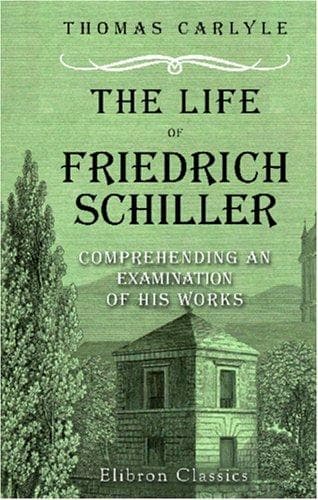
The Life of Friedrich Schiller: Comprehending an Examination of His WorksCarlyle, Thomas
General
The Life of Friedrich Schiller: Comprehending an Examination of His Works
Carlyle, Thomas
Authors, German -- 18th century -- Biography; Schiller, Friedrich, 1759-1805; Schubart, Christian Friedrich Daniel, 1739-1791
Once more upon the road without an aim, the wanderer turned to
Augsburg, simply as the nearest city, and—set up a Newspaper! The
_Deutsche Chronik_ flourished in his hands; in a little while it had
acquired a decided character for sprightliness and talent; in time it
became the most widely circulated journal of the country. Schubart was
again a prosperous man: his writings, stamped with the vigorous
impress of his own genius, travelled over Europe; artists and men of
letters gathered round him; he had money, he had fame; the rich and
noble threw their parlours open to him, and listened with delight to
his overflowing, many-coloured conversation. He wrote paragraphs and
poetry; he taught music and gave concerts; he set up a spouting
establishment, recited newly-published poems, read Klopstock's
_Messias_ to crowded and enraptured audiences. Schubart's evil genius
seemed asleep, but Schubart himself awoke it. He had borne a grudge
against the clergy, ever since his banishment from Ludwigsburg; and he
now employed the facilities of his journal for giving vent to it. He
criticised the priesthood of Augsburg; speculated on their selfishness
and cant, and took every opportunity of turning them and their
proceedings into ridicule. The Jesuits especially, whom he regarded as
a fallen body, he treated with extreme freedom; exposing their
deceptions, and holding up to public contumely certain quacks whom
they patronised. The Jesuitic Beast was prostrate, but not dead: it
had still strength enough to lend a dangerous kick to any one who came
too near it. One evening an official person waited upon Schubart, and
mentioned an _arrest_ by virtue of a warrant from the Catholic
Bürgermeister! Schubart was obliged to go to prison. The heads of the
Protestant party made an effort in his favour: they procured his
liberty, but not without a stipulation that he should immediately
depart from Augsburg. Schubart asked to know his crime; but the
Council answered him: "We have our reasons; let that satisfy you:" and
with this very moderate satisfaction he was forced to leave their
city.
Public-domain text, read in full here on John Shaqi.
Reviews
Reviews
No reviews yet
Be the first to share your thoughts on this work.
Elsewhere in the archive
Join the Discussion
Join the discussion
Sign in to leave a comment or review.
Sign InorCreate an account