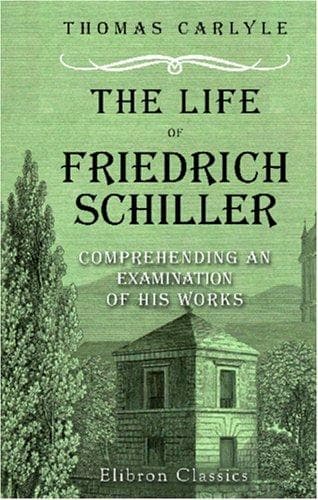
The Life of Friedrich Schiller: Comprehending an Examination of His WorksCarlyle, Thomas
General
The Life of Friedrich Schiller: Comprehending an Examination of His Works
Carlyle, Thomas
Authors, German -- 18th century -- Biography; Schiller, Friedrich, 1759-1805; Schubart, Christian Friedrich Daniel, 1739-1791
Another mitigating circumstance in Schubart's lot was the character of
his gaoler. This humane person had himself tasted the tender mercies
of 'paternal' government; he knew the nature of a dungeon better even
than his prisoner. 'For four years,' we are told, 'he had seen no
human face; his scanty food had been lowered to him through a
trap-door; neither chair nor table were allowed him, his cell was
never swept, his beard and nails were left to grow, the humblest
conveniences of civilised humanity were denied him!'[67] On this man
affliction had produced its softening, not its hardening influence: he
had grown religious, and merciful in heart; he studied to alleviate
Schubart's hard fate by every means within his power. He spoke
comfortingly to him; ministered to his infirmities, and, in spite of
orders, lent him all his books. These, it is true, were only treatises
on theosophy and mystical devotion; but they were the best he had; and
to Schubart, in his first lonely dungeon, they afforded occupation and
solace.
[Footnote 67: And yet Mr. Fox is reported to have said:
_There was one_ FREE _Government on the Continent, and that
one was—Würtemberg._ They had a parliament and 'three
estates' like the English.—So much for paper Constitutions!]
Human nature will accommodate itself to anything. The King of Pontus
taught himself to eat poison: Schubart, cut out from intemperance and
jollity, did not pine away in confinement and abstemiousness; he had
lost Voltaire and gay company, he found delight in solitude and Jacob
Böhm. Nature had been too good to him to let his misery in any case be
unalloyed. The vague unguided ebullience of spirit, which had so often
set the table in a roar, and made him the most fascinating of
debauchees, was now mellowed into a cloudy enthusiasm, the sable of
which was still copiously blended with rainbow colours. His brain had
received a slight though incurable crack; there was a certain
exasperation mixed with his unsettled fervour; but he was not
wretched, often even not uncomfortable. His religion was not real; but
it had reality enough for present purposes; he was at once a sceptic
and a mystic, a true disciple of Böhm as well as of Voltaire. For
afflicted, irresolute, imaginative men like Schubart, this is not a
rare or altogether ineffectual resource: at the bottom of their minds
they doubt or disbelieve, but their hearts exclaim against the
slightest whisper of it; they dare not look into the fathomless abyss
of Infidelity, so they cover it over with the dense and
strangely-tinted smoke of Theosophy. Schubart henceforth now and then
employed the phrases and figures of religion; but its principles had
made no change in his theory of human duties: it was not food to
strengthen the weakness of his spirit, but an opiate to stay its
craving.
Public-domain text, read in full here on John Shaqi.
Reviews
Reviews
No reviews yet
Be the first to share your thoughts on this work.
Elsewhere in the archive
Join the Discussion
Join the discussion
Sign in to leave a comment or review.
Sign InorCreate an account