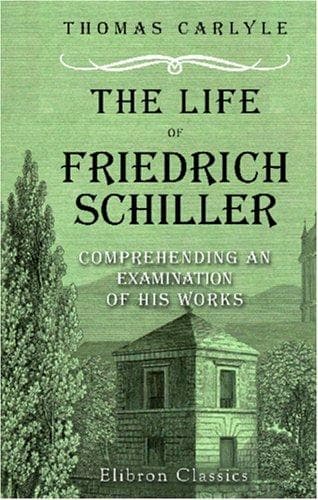
The Life of Friedrich Schiller: Comprehending an Examination of His WorksCarlyle, Thomas
General
The Life of Friedrich Schiller: Comprehending an Examination of His Works
Carlyle, Thomas
Authors, German -- 18th century -- Biography; Schiller, Friedrich, 1759-1805; Schubart, Christian Friedrich Daniel, 1739-1791
Time and hours wear out the roughest day. The world began to feel an
interest in Schubart, and to take some pity on him: his songs and
poems were collected and published; their merit and their author's
misery exhibited a shocking contrast. His Highness of Würtemberg at
length condescended to remember that a mortal, of wants and feelings
like his own, had been forced by him to spend, in sorrow and inaction,
the third part of an ordinary lifetime; to waste, and worse than
waste, ten years of precious time; time, of which not all the dukes
and princes in the universe could give him back one instant. He
commanded Schubart to be liberated; and the rejoicing Editor
(unacquitted, unjudged, unaccused!) once more beheld the blue zenith
and the full ring of the horizon. He joined his wife at Stuttgard, and
recommenced his newspaper. The _Deutsche Chronik_ was again popular;
the notoriety of its conductor made amends for the decay which critics
did not fail to notice in his faculties. Schubart's sufferings had in
fact permanently injured him; his mind was warped and weakened by
theosophy and solitude; bleak northern vapours often flitted over it,
and chilled its tropical luxuriance. Yet he wrote and rhymed;
discoursed on the corruption of the times, and on the means of their
improvement. He published the first portion of his Life, and often
talked amazingly about the Wandering Jew, and a romance of which he
was to form the subject. The idea of making old _Joannes a
temporibus_, the 'Wandering,' or as Schubart's countrymen denominate
him the 'Eternal Jew,' into a novel hero, was a mighty favourite with
him. In this antique cordwainer, as on a raft at anchor in the stream
of time, he would survey the changes and wonders of two thousand
years: the Roman and the Arab were to figure there; the Crusader and
the Circumnavigator, the Eremite of the Thebaid and the Pope of Rome.
Joannes himself, the Man existing out of Time and Space, Joannes the
unresting and undying, was to be a deeply tragic personage. Schubart
warmed himself with this idea; and talked about it in his cups, to the
astonishment of simple souls. He even wrote a certain rhapsody
connected with it, which is published in his poems. But here he
rested; and the project of the Wandering Jew, which Goethe likewise
meditated in his youth, is still unexecuted. Goethe turned to other
objects: and poor Schubart was surprised by death, in the midst of his
schemes, on the 10th of October 1791.
Public-domain text, read in full here on John Shaqi.
Reviews
Reviews
No reviews yet
Be the first to share your thoughts on this work.
Elsewhere in the archive
Join the Discussion
Join the discussion
Sign in to leave a comment or review.
Sign InorCreate an account