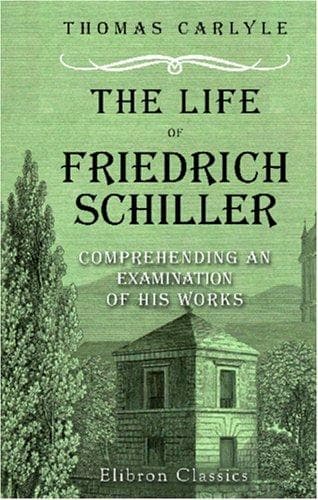
The Life of Friedrich Schiller: Comprehending an Examination of His WorksCarlyle, Thomas
General
The Life of Friedrich Schiller: Comprehending an Examination of His Works
Carlyle, Thomas
Authors, German -- 18th century -- Biography; Schiller, Friedrich, 1759-1805; Schubart, Christian Friedrich Daniel, 1739-1791
'Schiller had much more prudence and dexterity of management
than I: he was also thinking of his periodical the _Horen_,
about this time, and of course rather wished to attract than
repel me. Accordingly he answered me like an accomplished
Kantite; and as my stiff necked Realism gave occasion to
many contradictions, much battling took place between us,
and at last a truce, in which neither party would consent to
yield the victory, but each held himself invincible.
Positions like the following grieved me to the very soul:
_How can there ever be an experiment that shall correspond
with an idea? The specific quality of an idea is, that no
experiment can reach it or agree with it._ Yet if he held as
an idea the same thing which I looked upon as an experiment,
there must certainly, I thought, be some community between
us, some ground whereon both of us might meet! The first
step was now taken; Schiller's attractive power was great,
he held all firmly to him that came within his reach: I
expressed an interest in his purposes, and promised to give
out in the _Horen_ many notions that were lying in my head;
his wife, whom I had loved and valued since her childhood,
did her part to strengthen our reciprocal intelligence; all
friends on both sides rejoiced in it; and thus by means of
that mighty and interminable controversy between _object_
and _subject_, we two concluded an alliance, which remained
unbroken, and produced much benefit to ourselves and
others.'
The friendship of Schiller and Goethe forms so delightful a chapter in
their history, that we long for more and more details respecting it.
Sincerity, true estimation of each other's merit, true sympathy in
each other's character and purposes appear to have formed the basis of
it, and maintained it unimpaired to the end. Goethe, we are told, was
minute and sedulous in his attention to Schiller, whom he venerated as
a good man and sympathised with as an afflicted one: when in mixed
companies together, he constantly endeavoured to draw out the stores
of his modest and retiring friend; or to guard his sick and sensitive
mind from annoyances that might have irritated him; now softening, now
exciting conversation, guiding it with the address of a gifted and
polished man, or lashing out of it with the scorpion-whip of his
satire much that would have vexed the more soft and simple spirit of
the valetudinarian. These are things which it is good to think of: it
is good to know that there _are_ literary men, who have other
principles besides vanity; who can divide the approbation of their
fellow mortals, without quarrelling over the lots; who in their
solicitude about their 'fame' do not forget the common charities of
nature, in exchange for which the 'fame' of most authors were but a
poor bargain.
No. 4. Page 125.
Public-domain text, read in full here on John Shaqi.
Reviews
Reviews
No reviews yet
Be the first to share your thoughts on this work.
Elsewhere in the archive
Join the Discussion
Join the discussion
Sign in to leave a comment or review.
Sign InorCreate an account