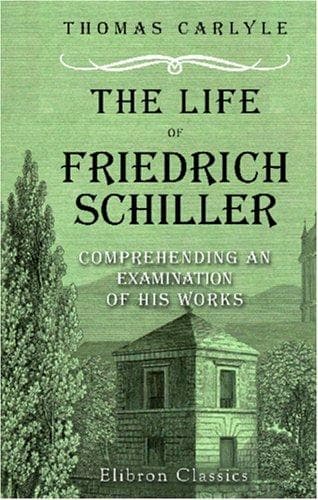
The Life of Friedrich Schiller: Comprehending an Examination of His WorksCarlyle, Thomas
General
The Life of Friedrich Schiller: Comprehending an Examination of His Works
Carlyle, Thomas
Authors, German -- 18th century -- Biography; Schiller, Friedrich, 1759-1805; Schubart, Christian Friedrich Daniel, 1739-1791
Had the character of Posa been drawn ten years later, it would have
been imputed, as all things are, to the 'French Revolution;' and
Schiller himself perhaps might have been called a Jacobin. Happily, as
matters stand, there is room for no such imputation. It is pleasing to
behold in Posa the deliberate expression of a great and good man's
sentiments on these ever-agitated subjects: a noble monument,
embodying the liberal ideas of his age, in a form beautified by his
own genius, and lasting as its other products.[16]
[Footnote 16: Jean Paul nevertheless, not without some show
of reason, has compared this Posa to the tower of a
lighthouse: 'high, far-shining,—empty!' (_Note of 1845._)]
Connected with the superior excellence of Posa, critics have remarked
a dramatic error, which the author himself was the first to
acknowledge and account for. The magnitude of Posa throws Carlos into
the shade; the hero of the first three acts is no longer the hero of
the other two. The cause of this, we are informed, was that Schiller
kept the work too long upon his own hands:
'In composing the piece,' he observes, 'many interruptions occurred;
so that a considerable time elapsed between beginning and concluding
it; and, in the mean while, much within myself had changed. The
various alterations which, during this period, my way of thinking and
feeling underwent, naturally told upon the work I was engaged with.
What parts of it had at first attracted me, began to produce this
effect in a weaker degree, and, in the end, scarcely at all. New
ideas, springing up in the interim, displaced the former ones; Carlos
himself had lost my favour, perhaps for no other reason than because I
had become his senior; and, from the opposite cause, Posa had occupied
his place. Thus I commenced the fourth and fifth acts with quite an
altered heart. But the first three were already in the hands of the
public; the plan of the whole could not now be re-formed; nothing
therefore remained but to suppress the piece entirely, or to fit the
second half to the first the best way I could.'
The imperfection alluded to is one of which the general reader will
make no great account; the second half is fitted to the first with
address enough for his purposes. Intent not upon applying the dramatic
gauge, but on being moved and exalted, we may peruse the tragedy
without noticing that any such defect exists in it. The pity and love
we are first taught to feel for Carlos abide with us to the last; and
though Posa rises in importance as the piece proceeds, our admiration
of his transcendent virtues does not obstruct the gentler feelings
with which we look upon the fate of his friend. A certain confusion
and crowding together of events, about the end of the play, is the
only fault in its plan that strikes us with any force. Even this is
scarcely prominent enough to be offensive.
Public-domain text, read in full here on John Shaqi.
Reviews
Reviews
No reviews yet
Be the first to share your thoughts on this work.
Elsewhere in the archive
Join the Discussion
Join the discussion
Sign in to leave a comment or review.
Sign InorCreate an account