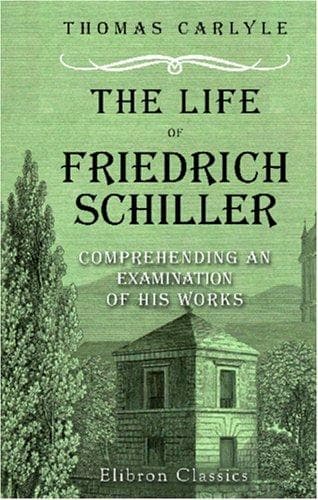
The Life of Friedrich Schiller: Comprehending an Examination of His WorksCarlyle, Thomas
General
The Life of Friedrich Schiller: Comprehending an Examination of His Works
Carlyle, Thomas
Authors, German -- 18th century -- Biography; Schiller, Friedrich, 1759-1805; Schubart, Christian Friedrich Daniel, 1739-1791
For a time he had hesitated what to choose; at length he began to
think of History. As a leading object of pursuit, this promised him
peculiar advantages. It was new to him; and fitted to employ some of
his most valuable gifts. It was grounded on reality, for which, as we
have said, his taste was now becoming stronger; its mighty revolutions
and events, and the commanding characters that figure in it, would
likewise present him with things great and moving, for which his taste
had always been strong. As recording the past transactions, and
indicating the prospects of nations, it could not fail to be
delightful to one, for whom not only human nature was a matter of most
fascinating speculation, but who looked on all mankind with the
sentiments of a brother, feeling truly what he often said, that 'he
had no dearer wish than to see every living mortal happy and contented
with his lot.' To all these advantages another of a humbler sort was
added, but which the nature of his situation forbade him to lose
sight of. The study of History, while it afforded him a subject of
continuous and regular exertion, would also afford him, what was even
more essential, the necessary competence of income for which he felt
reluctant any longer to depend on the resources of poetry, but which
the produce of his pen was now the only means he had of realising.
For these reasons, he decided on commencing the business of historian.
The composition of _Don Carlos_ had already led him to investigate the
state of Spain under Philip II.; and, being little satisfied with
Watson's clear but shallow Work on that reign, he had turned to the
original sources of information, the writings of Grotius, Strada, De
Thou, and many others. Investigating these with his usual fidelity and
eagerness, the Revolt of the Netherlands had, by degrees, become
familiar to his thoughts; distinct in many parts where it was
previously obscure; and attractive, as it naturally must be to a
temper such as his. He now determined that his first historical
performance should be a narrative of that event. He resolved to
explore the minutest circumstance of its rise and progress; to arrange
the materials he might collect, in a more philosophical order; to
interweave with them the general opinions he had formed, or was
forming, on many points of polity, and national or individual
character; and, if possible, to animate the whole with that warm
sympathy, which, in a lover of Freedom, this most glorious of her
triumphs naturally called forth.
Public-domain text, read in full here on John Shaqi.
Reviews
Reviews
No reviews yet
Be the first to share your thoughts on this work.
Elsewhere in the archive
Join the Discussion
Join the discussion
Sign in to leave a comment or review.
Sign InorCreate an account