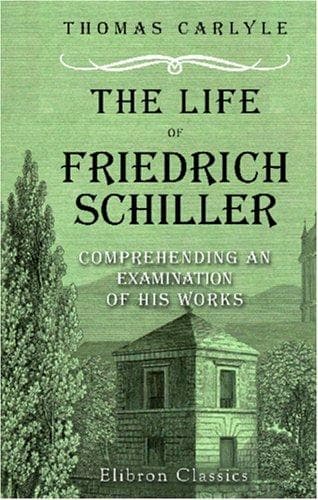
The Life of Friedrich Schiller: Comprehending an Examination of His WorksCarlyle, Thomas
General
The Life of Friedrich Schiller: Comprehending an Examination of His Works
Carlyle, Thomas
Authors, German -- 18th century -- Biography; Schiller, Friedrich, 1759-1805; Schubart, Christian Friedrich Daniel, 1739-1791
improvement; feeling more intensely as he feels more narrowly;
rejecting vehemently, choosing vehemently; at war with the one half of
things, in love with the other half; hence dissatisfied, impetuous,
without internal rest, and scarcely conceiving the possibility of such
a state. Apart from the difference of their opinions and mental
culture, Shakspeare and Milton seem to have stood in some such
relation as this to each other, in regard to the primary structure of
their minds. So likewise, in many points, was it with Goethe and
Schiller. The external circumstances of the two were, moreover, such
as to augment their several peculiarities. Goethe was in his
thirty-ninth year; and had long since found his proper rank and
settlement in life. Schiller was ten years younger, and still without
a fixed destiny; on both of which accounts, his fundamental scheme of
thought, the principles by which he judged and acted, and maintained
his individuality, although they might be settled, were less likely to
be sobered and matured. In these circumstances we can hardly wonder
that on Schiller's part the first impression was not very pleasant.
Goethe sat talking of Italy, and art, and travelling, and a thousand
other subjects, with that flow of brilliant and deep sense, sarcastic
humour, knowledge, fancy and good nature, which is said to render him
the best talker now alive.[18] Schiller looked at him in quite a
different mood; he felt his natural constraint increased under the
influence of a man so opposite in character, so potent in resources,
so singular and so expert in using them; a man whom he could not agree
with, and knew not how to contradict. Soon after their interview, he
thus writes:
'On the whole, this personal meeting has not at all diminished the
idea, great as it was, which I had previously formed of Goethe; but I
doubt whether we shall ever come into any close communication with
each other. Much that still interests me has already had its epoch
with him. His whole nature is, from its very origin, otherwise
constructed than mine; his world is not my world; our modes of
conceiving things appear to be essentially different. From such a
combination, no secure, substantial intimacy can result. Time will
try.'
[Footnote 18: 1825.]
The aid of time was not, in fact, unnecessary. On the part of Goethe
there existed prepossessions no less hostile; and derived from sources
older and deeper than the present transitory meeting, to the
discontents of which they probably contributed. He himself has lately
stated them with his accustomed frankness and good humour, in a
paper, part of which some readers may peruse with an interest more
than merely biographical.
Public-domain text, read in full here on John Shaqi.
Reviews
Reviews
No reviews yet
Be the first to share your thoughts on this work.
Elsewhere in the archive
Join the Discussion
Join the discussion
Sign in to leave a comment or review.
Sign InorCreate an account