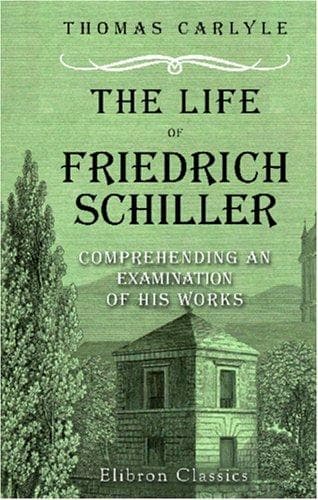
The Life of Friedrich Schiller: Comprehending an Examination of His WorksCarlyle, Thomas
General
The Life of Friedrich Schiller: Comprehending an Examination of His Works
Carlyle, Thomas
Authors, German -- 18th century -- Biography; Schiller, Friedrich, 1759-1805; Schubart, Christian Friedrich Daniel, 1739-1791
This work, which appeared in 1791, is considered by the German critics
as his chief performance in this department of literature: _The Revolt
of the Netherlands_, the only one which could have vied with it, never
was completed; otherwise, in our opinion, it might have been superior.
Either of the two would have sufficed to secure for Schiller a
distinguished rank among historians, of the class denominated
philosophical; though even both together, they afford but a feeble
exemplification of the ideas which he entertained on the manner of
composing history. In his view, the business of history is not merely
to record, but to interpret; it involves not only a clear conception
and a lively exposition of events and characters, but a sound,
enlightened theory of individual and national morality, a general
philosophy of human life, whereby to judge of them, and measure their
effects. The historian now stands on higher ground, takes in a wider
range than those that went before him; he can now survey vast tracts
of human action, and deduce its laws from an experience extending over
many climes and ages. With his ideas, moreover, his feelings ought to
be enlarged: he should regard the interests not of any sect or state,
but of mankind; the progress not of any class of arts or opinions, but
of universal happiness and refinement. His narrative, in short, should
be moulded according to the science, and impregnated with the liberal
spirit of his time.
Voltaire is generally conceived to have invented and introduced a new
method of composing history; the chief historians that have followed
him have been by way of eminence denominated philosophical. This is
hardly correct. Voltaire wrote history with greater talent, but
scarcely with a new species of talent: he applied the ideas of the
eighteenth century to the subject; but in this there was nothing
radically new. In the hands of a thinking writer history has always
been 'philosophy teaching by experience;' that is, such philosophy as
the age of the historian has afforded. For a Greek or Roman, it was
natural to look upon events with an eye to their effect on his own
city or country; and to try them by a code of principles, in which the
prosperity or extension of this formed a leading object. For a monkish
chronicler, it was natural to estimate the progress of affairs by the
number of abbeys founded; the virtue of men by the sum-total of
donations to the clergy. And for a thinker of the present day, it is
equally natural to measure the occurrences of history by quite a
different standard: by their influence upon the general destiny of
man, their tendency to obstruct or to forward him in his advancement
towards liberty, knowledge, true religion and dignity of mind. Each
of these narrators simply measures by the scale which is considered
for the time as expressing the great concerns and duties of humanity.
Public-domain text, read in full here on John Shaqi.
Reviews
Reviews
No reviews yet
Be the first to share your thoughts on this work.
Elsewhere in the archive
Join the Discussion
Join the discussion
Sign in to leave a comment or review.
Sign InorCreate an account