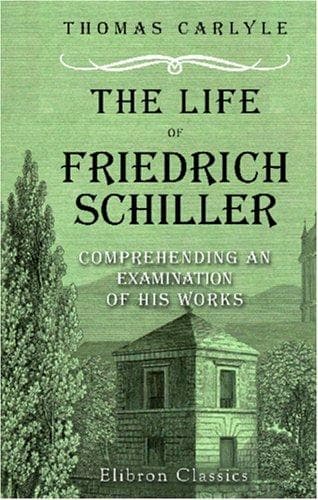
The Life of Friedrich Schiller: Comprehending an Examination of His WorksCarlyle, Thomas
General
The Life of Friedrich Schiller: Comprehending an Examination of His Works
Carlyle, Thomas
Authors, German -- 18th century -- Biography; Schiller, Friedrich, 1759-1805; Schubart, Christian Friedrich Daniel, 1739-1791
We have been compelled to offer these remarks on Kant's Philosophy;
but it is right to add that they are the result of only very limited
acquaintance with the subject. We cannot wish that any influence of
ours should add a note, however feeble, to the loud and not at all
melodious cry which has been raised against it in this country. When a
class of doctrines so involved in difficulties, yet so sanctioned by
illustrious names, is set before us, curiosity must have a theory
respecting them, and indolence and other humbler feelings are too
ready to afford her one. To call Kant's system a laborious dream, and
its adherents crazy mystics, is a brief method, brief but false. The
critic, whose philosophy includes the _craziness_ of men like these,
so easily and smoothly in its formulas, should render thanks to Heaven
for having gifted him with science and acumen, as few in any age or
country have been gifted. Meaner men, however, ought to recollect that
where we do not understand, we should postpone deciding, or, at least,
keep our decision for our own exclusive benefit. We of England may
reject this Kantean system, perhaps with reason; but it ought to be on
other grounds than are yet before us. Philosophy is science, and
science, as Schiller has observed, cannot always be explained in
'conversations by the parlour fire,' or in written treatises that
resemble such. The _cui bono_ of these doctrines may not, it is true,
be expressible by arithmetical computations: the subject also is
perplexed with obscurities, and probably with manifold delusions; and
too often its interpreters with us have been like 'tenebrific stars,'
that 'did ray out darkness' on a matter itself sufficiently dark. But
what then? Is the jewel always to be found among the common dust of
the highway, and always to be estimated by its value in the common
judgment? It lies embosomed in the depths of the mine; rocks must be
rent before it can be reached; skilful eyes and hands must separate it
from the rubbish where it lies concealed, and kingly purchasers alone
can prize it and buy it. This law of _ostracism_ is as dangerous in
science as it was of old in politics. Let us not forget that many
things are true which cannot be demonstrated by the rules of _Watts's
Logic_; that many truths are valuable, for which no price is given in
Paternoster Row, and no preferment offered at St. Stephen's! Whoever
reads these treatises of Schiller with attention, will perceive that
they depend on principles of an immensely higher and more complex
character than our 'Essays on Taste,' and our 'Inquiries concerning
the Freedom of the Will.' The laws of criticism, which it is their
purpose to establish, are derived from the inmost nature of man; the
scheme of morality, which they inculcate, soars into a brighter
region, very far beyond the ken of our 'Utilities' and 'Reflex-senses.'
They do not teach us 'to judge of poetry and art as we judge of
Public-domain text, read in full here on John Shaqi.
Reviews
Reviews
No reviews yet
Be the first to share your thoughts on this work.
Elsewhere in the archive
Join the Discussion
Join the discussion
Sign in to leave a comment or review.
Sign InorCreate an account