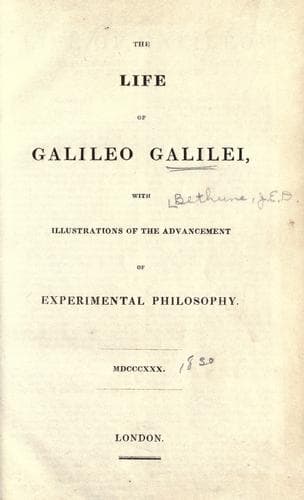
One of the most interesting subjects discussed in these dialogues is the
famous notion of Nature's horror of a vacuum or empty space, which the
old school of philosophy considered as impossible to be obtained.
Galileo's notions of it were very different; for although he still
unadvisedly adhered to the old phrase to denote the resistance
experienced in endeavouring to separate two smooth surfaces, he was so
far from looking upon a vacuum as an impossibility, that he has
described an apparatus by which he endeavoured to measure the force
necessary to produce one. This consisted of a cylinder, into which is
tightly fitted a piston; through the centre of the piston passes a rod
with a conical valve, which, when drawn down, shuts the aperture
closely, supporting a basket. The space between the piston and cylinder
being filled full of water poured in through the aperture, the valve is
closed, the vessel reversed, and weights are added till the piston is
drawn forcibly downwards. Galileo concluded that the weight of the
piston, rod, and added weights, would be the measure of the force of
resistance to the vacuum which he supposed would take place between the
piston and lower surface of the water. The defects in this apparatus for
the purpose intended are of no consequence, so far as regards the
present argument, and it is perhaps needless to observe that he was
mistaken in supposing the water would not descend with the piston. This
experiment occasions a remark from Sagredo, that he had observed that a
lifting-pump would not work when the water in the cistern had sunk to
the depth of thirty-five feet below the valve; that he thought the pump
was injured, and sent for the maker of it, who assured him that no pump
upon that construction would lift water from so great a depth. This
story is sometimes told of Galileo, as if he had said sneeringly on this
occasion that Nature's horror of a vacuum does not extend beyond
thirty-five feet; but it is very plain that if he had made such an
observation, it would have been seriously; and in fact by such a
limitation he deprived the notion of the principal part of its
absurdity. He evidently had adopted the common notion of suction, for he
compares the column of water to a rod of metal suspended from its upper
end, which may be lengthened till it breaks with its own weight. It is
certainly very extraordinary that he failed to observe how simply these
phenomena may be explained by a reference to the weight of the elastic
atmosphere, which he was perfectly well acquainted with, and endeavoured
by the following ingenious experiment to determine:—"Take a large glass
flask with a bent neck, and round its mouth tie a leathern pipe with a
valve in it, through which water may be forced into the flask with a
syringe without suffering any air to escape, so that it will be
compressed within the bottle. It will be found difficult to force in
more than about three-fourths of what the flask will hold, which must be
Public-domain text, read in full here on John Shaqi.
Reviews
Reviews
No reviews yet
Be the first to share your thoughts on this work.
Elsewhere in the archive
Join the Discussion
Join the discussion
Sign in to leave a comment or review.
Sign InorCreate an account