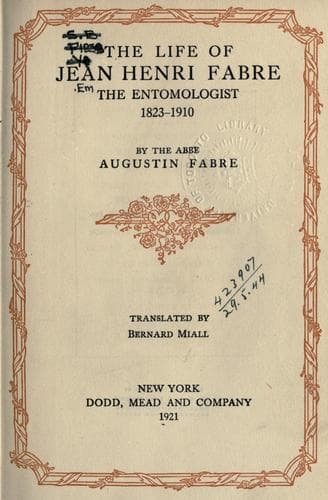
The life of Jean Henri Fabre, the entomologist, 1823-1910Fabre, Augustin
Science
The life of Jean Henri Fabre, the entomologist, 1823-1910
Fabre, Augustin
Entomologists -- France -- Biography; Fabre, Jean-Henri, 1823-1915
Like the pagès of his native country who live surrounded by their wives
and children, sharing their tasks and breaking bread with them, Fabre
loved to make his family share in his work as well as in his leisure.
He too was a worker in the fields, and was persuaded that, just as
there can never be too many hands at work to extract their wealth, so
there could never be too many eyes at work contemplating their wonders.
He made all his children, little as well as big, boys and girls, so
many collaborators in his researches, and he loved to scatter their
names about the pages of his books. And it is not the least charm of
the Souvenirs that we meet in them, at every step, the father hand in
hand with his children. Passing to and fro, like a refreshing breeze
that blows through the scientific aridities of the subject, we feel a
twofold current of sympathy flowing from the father to his children and
the naturalist to his insects.
Incapable of living without either of them, he found a way to devote
himself to both, and so closely that the bond between them was truly
one that held fast in life and death. Aglaé, Antonia, Claire, Emile,
and Jules were recruited in turn, and Fabre informs us that their help
was often of the greatest value in his entomological researches. And he
liked to attach his children’s names to those of his insects and his
discoveries. Jules above all was distinguished by these entomological
honours, which a father’s gratitude piously laid, with regretful tears,
upon his untimely grave.
Not content with dedicating to him the first volume of his Souvenirs,
Fabre again did homage to Jules in the second volume:
To my Son Jules.—Beloved child, my zealous collaborator in the
study of insects, my perspicacious assistant in the study of
plants, it was for your sake that I began this volume; I have
continued it for the sake of your memory, and I shall continue it
in the bitterness of my mourning. Ah! how hateful is death when it
reaps the flower in all the radiance of its blossoming! Your mother
and your sisters bring to your tomb wreaths gathered in the rustic
flower-bed that you delighted in. To these wreaths, faded by a
day’s sunshine, I add this book, which, I hope, will have a
to-morrow. It seems to me that it thus prolongs our common studies,
fortified as I am by my indomitable faith in a reawakening in the
Beyond. [89]
When the separation from loved ones wounds the heart so grievously and
wrings from the soul such accents of hope and faith, we need seek no
other standard to judge a man’s moral worth.
The spectacle of a man, thus moved by the death of his dear ones, who
yet welcomes his own death with serenity, is admirable. Such was the
case with Fabre, as proved by the following episode of the same
date—i.e. 1879.
I am living at Orange in the year 1879. My house stands alone among
the fields....
Public-domain text, read in full here on John Shaqi.
Reviews
Reviews
No reviews yet
Be the first to share your thoughts on this work.
Elsewhere in the archive
Join the Discussion
Join the discussion
Sign in to leave a comment or review.
Sign InorCreate an account