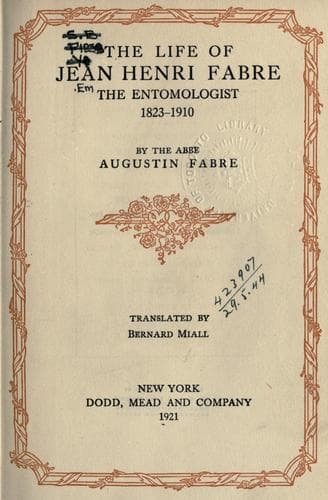
The life of Jean Henri Fabre, the entomologist, 1823-1910Fabre, Augustin
Science
The life of Jean Henri Fabre, the entomologist, 1823-1910
Fabre, Augustin
Entomologists -- France -- Biography; Fabre, Jean-Henri, 1823-1915
Starting from Orange and crossing the Aygues, a torrent whose muddy
waters are lost in the Rhône, but whose bed is dried by the July
and August suns, leaving only a desert of pebbles, where the
Mason-bee builds her pretty turrets of rock-work, we come presently
to the Sérignaise country; an arid, stony tract, planted with vines
and olives, coloured a rusty red, or touched here and there with
almost the hue of blood; and here and there a grove of cypress
makes a sombre blot. To the north runs a long black line of hills,
covered with box and ilex and the giant heather of the south. Far
in the distance, to the east, the immense plain is closed in by the
wall of Saint-Amant and the ridge of the Dentelle, behind which the
lofty Ventoux rears its rocky, cloven bosom abruptly to the clouds.
At the end of a few miles of dusty road, swept by the powerful
breath of the mistral, we suddenly reach a little village. It is a
curious little community, with its central street adorned by a
double row of plane-trees, its leaping fountains, and its almost
Italian air. The houses are lime-washed, with flat roofs; and
sometimes, at the side of some small or decrepit dwelling, we see
the unexpected curves of a loggia. At a distance the façade of the
church has the harmonious lines of a little antique temple; close
at hand is the graceful campanile, an old octagonal tower
surmounted by a narrow mitre wrought in hammered iron, in the midst
of which are seen the black profiles of the bells.
At the entrance of the little market-town, in a solitary corner, in
the centre of an enclosure of lofty walls, which are taller than
the crests of the pines and cypresses, Fabre’s dwelling is hidden
away. A pink house with green shutters, half-hidden amid the sombre
foliage, appears at the end of an alley of lilacs, “which sway in
the spring under the weight of their balmy thyrsi.” Before the
house are the shady plane-trees, where during the burning hours of
August the cicada of the flowering ash, the deafening cacan,
concealed beneath the leaves, fills the hot atmosphere with its
eager cries, the only sound that disturbs the profound silence of
this solitude.
There, in this “hermit’s retreat,” as he himself has defined it,
the sage is voluntarily sequestered; a true saint of science, an
ascetic living only on fruits, vegetables, and a little wine; so in
love with retirement that even in the village he was for a long
time almost unknown, so careful was he to go round instead of
through it on his way to the neighbouring mountain, where he would
often spend whole days alone with wild nature.
Public-domain text, read in full here on John Shaqi.
Reviews
Reviews
No reviews yet
Be the first to share your thoughts on this work.
Elsewhere in the archive
Join the Discussion
Join the discussion
Sign in to leave a comment or review.
Sign InorCreate an account