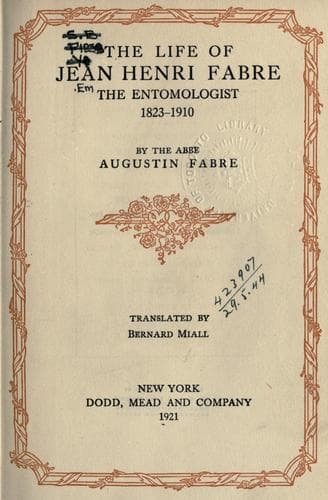
The life of Jean Henri Fabre, the entomologist, 1823-1910Fabre, Augustin
Science
The life of Jean Henri Fabre, the entomologist, 1823-1910
Fabre, Augustin
Entomologists -- France -- Biography; Fabre, Jean-Henri, 1823-1915
This is what I wished for, hoc erat in votis: a bit of land, oh,
not so very large, but fenced in, to avoid the drawbacks of a
public way; an abandoned, barren, sun-scorched bit of land,
favoured by thistles and by Wasps and Bees. Here, without distant
expeditions that take up my time, without tiring rambles that
strain my nerves, I could contrive my plans of attack, lay my
ambushes, and watch their effects at every hour of the day. Hoc
erat in votis. Yes, this was my wish, my dream, always cherished,
always vanishing into the mists of the future.
And it is no easy matter to acquire a laboratory in the open
fields, when harassed by a terrible anxiety about one’s daily
bread. For forty years have I fought, with steadfast courage,
against the paltry plagues of life; and the long-wished-for
laboratory has come at last. What it has cost me in perseverance
and relentless work I will not try to say. It has come; and with
it—a more serious condition—perhaps a little leisure. I say
perhaps, for my leg is still hampered by a few links of the
convict’s chain.
But this is not my business for the moment: I want to speak of the
bit of land long cherished in my plans to form a laboratory of
living entomology, the bit of land which I have at last obtained in
the solitude of a little village. It is a harmas, the name given,
in this district, [93] to an untilled, pebbly expanse abandoned to
the vegetation of the thyme. It is too poor to repay the work of
the plough; but the sheep passes there in spring, when it has
chanced to rain and a little grass shoots up.
My harmas, however, because of its modicum of red earth, swamped by
a huge mass of stones, has received a rough first attempt at
cultivation: I am told that vines once grew here. The three-pronged
fork is the only implement of husbandry that can penetrate such a
soil as this; and I am sorry, for the primitive vegetation has
disappeared. No more thyme, no more lavender, no more clumps of
kermes-oak, the dwarf oak that forms forests across which we step
by lengthening our stride a little. As these plants, especially the
first two, might be of use to me by offering the Bees and Wasps a
spoil to plunder, I am compelled to reinstate them in the ground
whence they were driven by the fork.
Public-domain text, read in full here on John Shaqi.
Reviews
Reviews
No reviews yet
Be the first to share your thoughts on this work.
Elsewhere in the archive
Join the Discussion
Join the discussion
Sign in to leave a comment or review.
Sign InorCreate an account