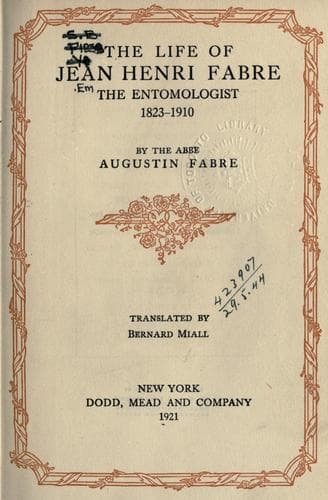
The life of Jean Henri Fabre, the entomologist, 1823-1910Fabre, Augustin
Science
The life of Jean Henri Fabre, the entomologist, 1823-1910
Fabre, Augustin
Entomologists -- France -- Biography; Fabre, Jean-Henri, 1823-1915
With its peaceful plains, its gracious hills, overgrown with
strawberry-tree and ilex, and the sublime mountain of Provence rising
upon the horizon, with its varied outlines and its sun-illumined
flanks, the Sérignan landscape gently forces itself upon the
spectator’s attention. And if the spirit moved him, Fabre had only to
raise his head from his apparatus to find all about him something to
soothe the eye and refresh the mind.
But however keen his feeling for the beauties of Nature, it is not so
much as artist or dilettante but as the insect historiographer that he
appreciates the value of the landscape, and the wealth of the plains
and hills outspread before him.
From this point of view the whole surroundings of his hermitage seem as
though created to continue and complete the harmas, and the scientific
pleasures which this affords him.
The Gymnopleuri abound in the pebbly plains of the neighbourhood,
where the sheep pass amid the lavender and thyme; and, should we
wish to vary the scene of observation, the mountain [99] is but a
few hundred steps away, with its tangle of arbutus, rock-roses, and
arborescent heather; with its sandy spaces dear to the Bembeces;
with its marly slopes exploited by different Wasps and Bees.
We have already made mention of the Aygues, and the time has come to
pay it a formal visit, as one of the favourite haunts of the Sérignan
hermit:
The geographers define the Aygues as a watercourse. As an
eye-witness I should call it rather a stream of flat pebbles.
Understand me: I do not mean that the dry pebbles flow of their own
accord; the feeble incline would not permit of such an avalanche.
But let it rain: then they will flow. Then, from my home, which is
more than a mile distant, I hear the uproar of the clashing
pebbles.
During the greater part of the year the Aygues is a vast sheet of
flat white stones; of the torrent only the bed is left, a furrow of
enormous width, comparable to that of its mighty neighbour, the
Rhône. When persistent rains fall, when the snows melt on the
slopes of the Alps, the dry furrow fills for a few days,
complaining, overflowing to a great distance, and displacing, amid
the uproar, its pebbly banks. Return a week later: the din of the
flood is succeeded by silence. The terrible waters have
disappeared, leaving on the banks, as a trace of their brief
passage, some wretched muddy puddles quickly drunk up by the sun.
Public-domain text, read in full here on John Shaqi.
Reviews
Reviews
No reviews yet
Be the first to share your thoughts on this work.
Elsewhere in the archive
Join the Discussion
Join the discussion
Sign in to leave a comment or review.
Sign InorCreate an account