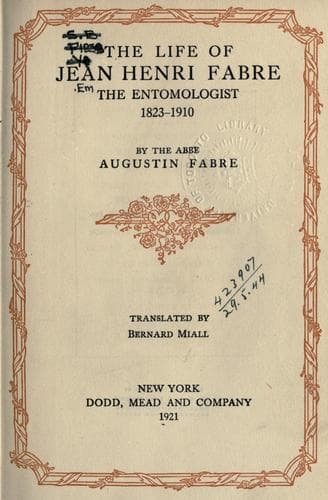
The life of Jean Henri Fabre, the entomologist, 1823-1910Fabre, Augustin
Science
The life of Jean Henri Fabre, the entomologist, 1823-1910
Fabre, Augustin
Entomologists -- France -- Biography; Fabre, Jean-Henri, 1823-1915
Nor shall I find it in my father. The excellent man, who was
hard-working and sturdily-built like grandad, had been to school as
a child. He knew how to write, though he took the greatest
liberties with spelling; he knew how to read and understood what he
read, provided the reading presented no more serious literary
difficulties than occurred in the stories in the almanack. He was
the first of his line to allow himself to be tempted by the town,
and he lived to regret it. Badly off, having but little outlet for
his industry, making God knows what shifts to pick up a livelihood,
[103] he went through all the disappointments of the countryman
turned townsman. Persecuted by bad luck, borne down by the burden
for all his energy and good will, he was far indeed from starting
me in entomology. He had other cares, cares more direct and more
serious. A good cuff or two when he saw me pinning an insect to a
cork was all the encouragement that I received from him. Perhaps he
was right.
The conclusion is positive: there is nothing in heredity to explain
my taste for observation. You may say that I do not go far enough
back. Well, what should I find beyond the grandparents where my
facts come to a stop? I know, partly. I should find even more
uncultured ancestors: sons of the soil, ploughmen, sowers of rye,
neat-herds; one and all, by the very force of things, of not the
least account in the nice matters of observation. [104]
Between the parents and the son, what a difference, what a change of
life and of destiny! Quantum mutatus ab illis! This, no doubt, is the
first thing to strike one; and here, too, we have one of the most
salient features of the superiority of the human intelligence; this
almost infinite possibility of transformation and progress, which forms
such a striking contrast with the rigid immutability of instinct which
is barely susceptible of the slightest variation.
But for all this Fabre still bears the stamp of the soil and of his
ancestry, and I am certain that the pagès of the banks of the Viaur,
were they to descend to the banks of the Aygues to visit the hermit of
Sérignan, would recognise by more than one characteristic the child of
their native soil and their own race. Under his wide felt hat, “in his
linen jacket” [105] and his heavy shoes, with a face like theirs in its
simplicity and good nature, he would see almost one of themselves. And
if, after entering his home, they were to follow him into the
enclosure, among his crops and his appliances, if they were to see him
valiantly digging up the soil of the harmas in search of fresh burrows
of the Scarabæi, or assembling a few thick planks to contrive some new
entomological apparatus, or simply beating the brushwood over his
inverted umbrella in search of insects, they would certainly be tempted
to join in and lend him a hand as though dealing with a
fellow-labourer.
Public-domain text, read in full here on John Shaqi.
Reviews
Reviews
No reviews yet
Be the first to share your thoughts on this work.
Elsewhere in the archive
Join the Discussion
Join the discussion
Sign in to leave a comment or review.
Sign InorCreate an account