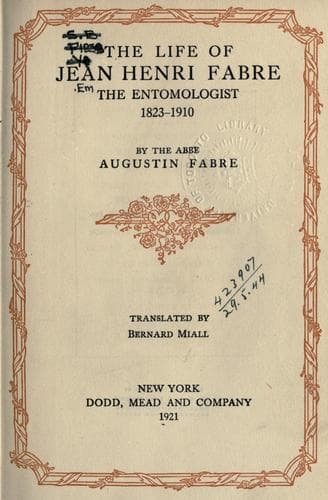
The life of Jean Henri Fabre, the entomologist, 1823-1910Fabre, Augustin
Science
The life of Jean Henri Fabre, the entomologist, 1823-1910
Fabre, Augustin
Entomologists -- France -- Biography; Fabre, Jean-Henri, 1823-1915
When we attempted discreetly to lift the veil of his first retirement
from Orange, which seemed to us peculiarly characteristic of his
private life, we had occasion to note the eminently domestic nature of
his life and work, and the assiduous collaboration in the common task
of the first-born of his children. We have seen Antonia, Claire, Jules
and Emile [122] rivalling one another in their eagerness to assist in
their father’s observations, and this charming devotion outlived the
youthful ardour of the early springtide of life.
Sometimes, too, the children anticipate their father’s entomological
desires. For example, his son Emile sends him from the neighbourhood of
Marseilles a nest of resin-working Hymenoptera. [123] His daughter
Claire sends him, from another part of Provence, an entomological
document of such value that it “reawakened all the enthusiasm of his
early years.” It related to one of his favourite insects, another
Hymenopteron, the Nest-building Odynerus.
It was the end of February. The weather was mild; the sun was kind.
Setting out in a family party, with food for the children, apples,
and a piece of a loaf in the basket, we were going to see the
almond-trees in flower. When it was time for lunch we halted under
the great oak-trees, when Anna, the youngest of the household,
always on the look-out for small creatures with her new,
six-year-old eyes, called to me, at a few paces’ distance from our
party. “An animal,” she said, “two, three, four—and pretty ones!
Come and see, papa, come and see!” [124]
This was one of the rarest discoveries: a dozen specimens of the Pearly
Trox, which were making a meal off a little rabbit’s down which some
fox’s stomach had been unable to exploit. “There is every sort of taste
in this world, so that nothing shall be wasted!”
And not once or twice, but every moment almost, little Paul, [125]
Marie Pauline, [126] and Anna enliven the narrative by their delightful
appearances and their inventive activity. Little Paul above all is an
auxiliary of the highest value, who deserves to be introduced to the
reader as an acknowledged collaborator:
I speak of my son Paul, a little chap of seven. My assiduous
companion on my hunting expeditions, he knows better than any one
of his age the secrets of the Cicada, the Locust, the Cricket, and
especially the Dung-beetle, his great delight. Twenty paces away,
his sharp eyes will distinguish the real mound that marks a burrow
from casual heaps of earth; his delicate ears catch the
Grasshopper’s faint stridulation, which to me remains silent. He
lends me his sight and hearing; and I, in exchange, present him
with ideas, which he receives attentively, raising wide, blue,
questioning eyes to mine.
Public-domain text, read in full here on John Shaqi.
Reviews
Reviews
No reviews yet
Be the first to share your thoughts on this work.
Elsewhere in the archive
Join the Discussion
Join the discussion
Sign in to leave a comment or review.
Sign InorCreate an account