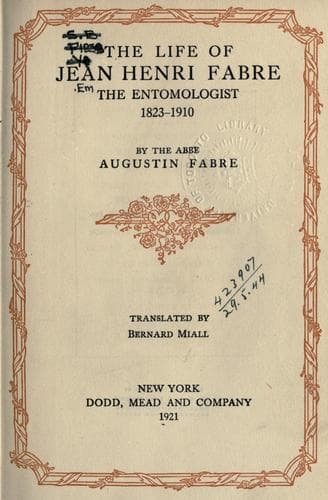
The life of Jean Henri Fabre, the entomologist, 1823-1910Fabre, Augustin
Science
The life of Jean Henri Fabre, the entomologist, 1823-1910
Fabre, Augustin
Entomologists -- France -- Biography; Fabre, Jean-Henri, 1823-1915
We are, indeed, glad to think that if he was unduly overlooked at a
later time, he was at least known and admired at an early period in
Aveyron, and that as early as 1866 his class books were especially
recommended to the attention of our young schoolmasters at the Normal
College of Rodez. They could have had none better conceived or
compiled. Would to heaven our public schoolmasters had always been as
happily inspired or as well advised in the choice of their textbooks!
Would to heaven that, instead of the dismal and misleading suggestions
of materialism and impiety, there were still a place in the manuals of
science, put in the hands of our children, for reflections as sane and
as lofty as these. “By their practical side the sciences verge upon
agriculture, medicine, and industry; but they have before all a moral
advantage which is not shared in the same degree by any other branch of
human knowledge: in that by giving us a knowledge of the created
universe they uplift the soul and nourish the mind with noble and
salutary thoughts.” [149]
The study of the heavenly bodies in particular has this inestimable
result: “The things that we are told by stellar astronomy overwhelm the
understanding and leave no room in our minds except for an impulse of
religious wonder at the author of these marvels, the God whose
unlimited power has peopled the abysses of space with immeasurable
heaps of suns.” [150] But the divine work “perhaps appears more
marvellous still in the infinity of littleness than in the infinity of
magnitude: Magnus in magnis, it has been said of God, maximus in
minimis.” [151] This fine saying is verified and more or less
explicitly confirmed in a thousand passages of the Souvenirs.
Fabre’s works of popularisation are very numerous: they include no less
than seventy to eighty volumes; they embrace all the elements of the
sciences learned and taught by the author: arithmetic, algebra,
geometry, trigonometry, mechanics, physics, chemistry, etc.; but their
principal aim was to teach the natural sciences, which furnish the
material of more than fifty volumes intended for the primary or
secondary degree of education.
In his favourite domain of the natural sciences, as in that of the
other sciences, the practical tendency of his teaching was by
preference directed toward agricultural applications, as is shown by
the very titles of many of his books: Eléments usuels des sciences
physiques et naturelles, avec applications à l’hygiène et a
l’agriculture—Le Livre des Champs—Les Auxiliaires—Les
Ravageurs—Arithmétique agricole—Chimie agricole: indeed it was with the
last volume that he inaugurated his series of initiatory textbooks. For
the use of young girls and future housewives, he published books on Le
Ménage, Hygiène and Economie domestique.
Public-domain text, read in full here on John Shaqi.
Reviews
Reviews
No reviews yet
Be the first to share your thoughts on this work.
Elsewhere in the archive
Join the Discussion
Join the discussion
Sign in to leave a comment or review.
Sign InorCreate an account