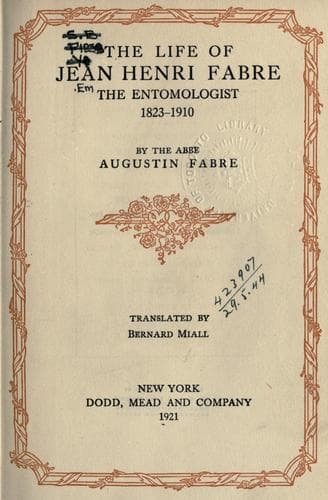
The life of Jean Henri Fabre, the entomologist, 1823-1910Fabre, Augustin
Science
The life of Jean Henri Fabre, the entomologist, 1823-1910
Fabre, Augustin
Entomologists -- France -- Biography; Fabre, Jean-Henri, 1823-1915
“With the originality of genius he is from the first totally opposed to
the point of view of those naturalists who are fascinated by morphology
and anatomy.” [156] He believes that the characteristics of life are to
be found in life itself, and that if we wish truly to know the insect,
nothing will help us so much as seeing it at work. “Mere common sense,
the reader will say, yet it is by no means common”; and it usually
happens that writers “forget to take performance into their reckoning
when they are describing life.” [157]
To study living entomology, that is, to study the insect living its
life and in the highest manifestations of its life, in its instincts
and its habits, in its aptitudes and its passions, in a word, in its
psychic faculties; to replace the dominant standpoint of morphology and
physiology by the standpoint of biology and psychology; such is the
essential programme of the writer of the Souvenirs.
And he adheres to it all the more strictly the more he sees it
neglected by those about him, judging it to be of still greater
importance for one who is seeking to know the insect, more advantageous
to practice and speculation, more essential to the open-air life and
the most abstruse inquiries of the human mind. By curiously
interrogating the life of the insects one may render inestimable
services to agriculture, as Pasteur did in his investigation of
sericulture; one may also “furnish general psychology with data of
inestimable value,” and this in particular was what he proposed to do.
M. Fabre’s restless mind is for ever haunted by the most abstruse
problems, which, indicated here and there, enable us to understand the
motives that urge him on. With reference to these the insect is no
longer an end: it becomes a means. Above all, M. Fabre wishes to define
instinct; to establish the line of demarcation which divides it from
intelligence, and to demonstrate whether human reason is an irreducible
faculty or whether it is only a degree higher on a scale whose base
descends into the depths of animality. More generally he propounds the
question of the identity or the difference between the animal mind and
the human. He also seeks to examine the problem of evolution; finally,
to discover whether geometry rules over all things, and whether it
tells us of a Universal Geometer, or whether “the strictly beautiful,
the domain of reason, that is, order, is the inevitable result of a
blind mechanism.” [158]
And to tell the whole story in a few words, the essential object, the
general impulse of this curious and powerful mind, which refuses to
divide science from philosophy, is to consider the insect, how it
lives; to note its actions and its movements; to reach its inner from
its outer life; its inward impulse from its external action; and then
to climb upwards from the insect to man and from man to God.
Public-domain text, read in full here on John Shaqi.
Reviews
Reviews
No reviews yet
Be the first to share your thoughts on this work.
Elsewhere in the archive
Join the Discussion
Join the discussion
Sign in to leave a comment or review.
Sign InorCreate an account