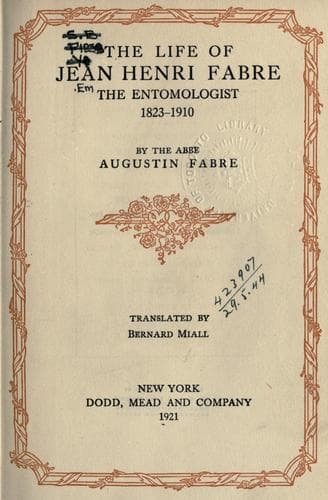
The life of Jean Henri Fabre, the entomologist, 1823-1910Fabre, Augustin
Science
The life of Jean Henri Fabre, the entomologist, 1823-1910
Fabre, Augustin
Entomologists -- France -- Biography; Fabre, Jean-Henri, 1823-1915
To collect the data which he requires for the foundation of his
philosophical structures, Fabre is not content with observing the
insect as it lives and labours when left to itself, writing down, so to
speak, at its dictation the data which it deigns to give him as it
would give them to any one who possessed the same patience and the same
gift for observation. After these first overtures, he seeks more
confidential information; to obtain this he inverts the parts played by
observer and insect; from being passive he becomes active; he provokes
and interrogates, and by different experiments, often of wonderful
ingenuity, he enables and even compels the insect to confide to him
what it would never have divulged in the normal course of its life and
occupations. Fabre is the first to think of introducing this kind of
artificial observation, which he calls experiment, into the study of
the animal “soul.”
To practise it more readily, he needs the insect close within his
reach; more than that, he needs it under his hand, at his discretion,
so to say. Neither the great museum of the fields nor the place of
observation where the insects “roam at will amid the thyme and
lavender” quite answers the requirements of this part of his programme.
So at various points of the harmas all those appliances which we have
already described were set up, “rustic achievements, clumsy
combinations of trivial things.” In addition to these appliances in the
open air, there are those inside the house: some are installed in the
study, so that the experimenter “can see his insects working on the
very table upon which he is writing their history”; [160] others are
arranged in a separate room known as the “animal laboratory.”
It is a great, silent, isolated room, brilliantly lighted by two
windows facing south, upon the garden, one of which at least is
always open that the insects may come and go at liberty.... The
middle of the room is entirely occupied by a great table of
walnut-wood, on which are arranged bottles, test-tubes, and old
sardine boxes, which Fabre employs in order to watch the evolution
of a thousand nameless or doubtful eggs, to observe the labours of
their larvæ, the creation and hatching of cocoons, and the little
miracles of metamorphosis, after a germination more wonderful than
that of the acorn which makes the oak.
Covers of metallic gauze resting on earthenware saucers full of
sand, a few carboys and flower-pots or sweetmeat jars closed with a
square of glass; these serve for observation or experimental cages
in which the progress and the actions of these tiny, living
machines can be investigated. [161]
Public-domain text, read in full here on John Shaqi.
Reviews
Reviews
No reviews yet
Be the first to share your thoughts on this work.
Elsewhere in the archive
Join the Discussion
Join the discussion
Sign in to leave a comment or review.
Sign InorCreate an account