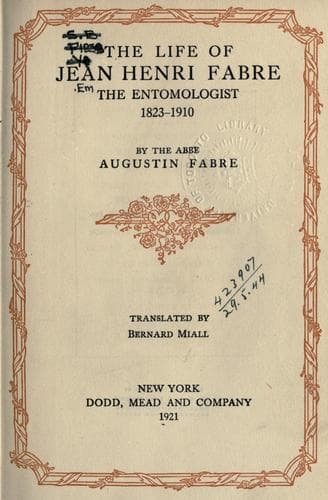
The life of Jean Henri Fabre, the entomologist, 1823-1910Fabre, Augustin
Science
The life of Jean Henri Fabre, the entomologist, 1823-1910
Fabre, Augustin
Entomologists -- France -- Biography; Fabre, Jean-Henri, 1823-1915
Needless to say that the whole assembly accepted their president’s
proposal with enthusiasm and by acclamation. Some time later the famous
naturalist wrote to the Society, through his present biographer, a
touching letter of thanks, in which he said, among other things, that,
coming from his own country, this distinction had been very precious to
him. The delicate feeling expressed in these words gives us to hope
that the contribution to the work of reparation which we have sought to
make will not be without some value in his eyes.
CHAPTER XXII
THE LAST HEIGHTS [197] (1910–1915)
I
In the year 1910 Fame flung the gate of the harmas wide open. Coming
late, she seemed anxious to repair her long neglect.
The process of reparation continued. It grew fuller, more marked, and
burst into a splendid apotheosis during the following years.
Scientists as a class had accused Fabre of mixing up Horace and Virgil
with his entomological adventures. He was despised for quoting these
authors; he was placed upon the Index for introducing grace and passion
into studies which officially were dry and cold as statistics. But in
joining the Académie Française on the occasion of the jubilee of 1910,
the Académie des Sciences gloriously avenged this unjust and
Pharisaical disdain.
But there were yet some of “time’s revenges” to be taken for the
injustice which Fabre had suffered.
We have spoken of his early struggles in the University, of his career,
first hampered, then shattered, of the jealousies and persecutions
evoked by this “irregular” self-taught pioneer; no doubt the work of a
triumphant clique, which eventually drove him from the house and
slammed the door. This was, as the reader may remember, on the occasion
of his lecture to young girls at Saint-Martial.
But now, on the 23rd of April 1911, a fresh invasion of young girls,
almost all pupils of the University, burst into the harmas. [198] And
what had they to say? That they came from Paris to visit the glories of
Provence, and that next to Mistral they had wished to see Fabre, after
the “emperor of poetry,” the “king of science,” and they made it clear
that it was not only to the scientist, but still more to the pioneer,
the initiator—or why not say, with them, to the most illustrious of
“cronies” [199]—that the girl “cronies,” as they called one another in
their group, had come to present their heart-felt homage. Who to-day
would dare to contest their right to become his pupils, to seek with
him “the freshest honey and the most poetical observations of the
insects that people the boughs and the flowers,” to enter with him into
the secret of all these little lives, “which are, like ourselves,” they
said, “creatures of the good God”?
And serious personages [200] from the precincts of the Académie and the
Université de France lent voice and gesture to the ingenuous utterance
of radiant youth, which delightfully made amends for the past.
Public-domain text, read in full here on John Shaqi.
Reviews
Reviews
No reviews yet
Be the first to share your thoughts on this work.
Elsewhere in the archive
Join the Discussion
Join the discussion
Sign in to leave a comment or review.
Sign InorCreate an account