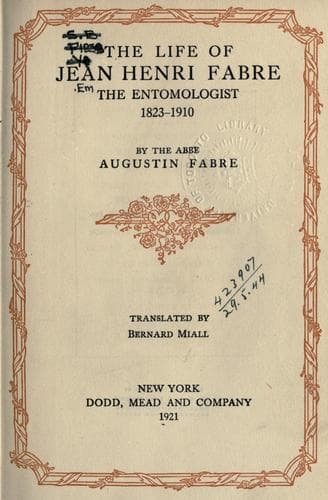
The life of Jean Henri Fabre, the entomologist, 1823-1910Fabre, Augustin
Science
The life of Jean Henri Fabre, the entomologist, 1823-1910
Fabre, Augustin
Entomologists -- France -- Biography; Fabre, Jean-Henri, 1823-1915
Fabre was preceded to the tomb by several months by Mistral, who was
seven years his junior. “Very different in an equal fame, these two men
are inseparable. Mistral and Fabre both represented Provence; one was
born there and never left it, and to some extent created it; the other
adopted and was adopted by it, and, like his illustrious compatriot,
covered it with glory.” [211]
But while Fabre represented Provence, which saw the unfolding of his
rich and vital nature, and while it lavished upon him all the beauty of
its sky, all the brilliance of its Latin soul, all the savour of its
musical and picturesque language, and all the entomological wealth of
its sunny hills, he none the less represents the Rouergue, whence he
derived his innate qualities and his earliest habits, his love of
nature and the insects, his thirst for God and the Beyond, his
indefatigable love of work, his tenacious enthusiasm for study, his
irresistible craving for solitude, the strange, powerful, striking and
picturesque grace of his language, his almost rustic simplicity, his
blunt frankness, his proud timidity, his no less proud independence,
and with all these the ingenuous and unusual sensitiveness and sincere
modesty of his character.
THE END
NOTES
[1] The higher clerical seminary.—B. M.
[2] The great entomologist’s jubilee was celebrated on the April 3,
1910.—Author’s Note.
[3] Paris, Delagrave. The Souvenirs, translated by Alexander Teixeira
de Mattos, are in course of publication by Messrs. Hodder and Stoughton
in England and Messrs. Dodd, Mead and Co. in the United States. The
arrangement of the essays has been altered in the English series. See
also The Life and Love of the Insect, translated by Alexander Teixeira
de Mattos (A. and C. Black), Social Life in the Insect World,
translated by Bernard Miall (T. Fisher Unwin), and Wonders of Instinct,
translated by Alexander Teixeira de Mattos and Bernard Miall (T. Fisher
Unwin).—B. M.
[4] It must in justice be admitted that Fabre had certain precursors,
among whom mention must be made of the famous Réaumur and Léon Dufour,
a physician who lived in the Landes (died 1865), and who was the
occasion and the subject of his first entomological publication. This
does not alter the fact that his great work is not only absolutely
original, but an achievement sui generis which cannot be compared with
the mere sketches of his predecessors.
[5] Souvenirs, Series VI., p. 65, The Life of the Fly, chap. vi., “My
Schooling.” This is Fabre’s verdict upon another naturalist,
Moquin-Tandon.
[6] Souvenirs, VI., pp. 76–97; The Glow-worm and Other Beetles, chap,
ix., “Dung-beetles of the Pampas.”
[7] M. E. Perrier is a Member of the Institut de France.
[8] Souvenirs, VI., pp. 76, 97; The Glow-worm, chap. ix.
Public-domain text, read in full here on John Shaqi.
Reviews
Reviews
No reviews yet
Be the first to share your thoughts on this work.
Elsewhere in the archive
Join the Discussion
Join the discussion
Sign in to leave a comment or review.
Sign InorCreate an account