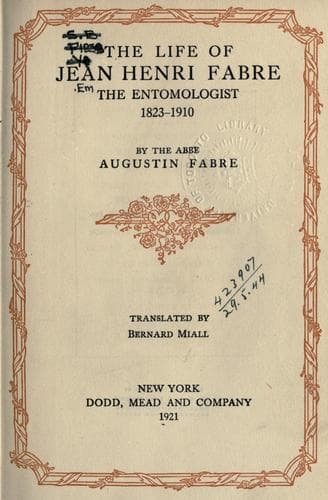
The life of Jean Henri Fabre, the entomologist, 1823-1910Fabre, Augustin
Science
The life of Jean Henri Fabre, the entomologist, 1823-1910
Fabre, Augustin
Entomologists -- France -- Biography; Fabre, Jean-Henri, 1823-1915
[193] Fabre appears to conceive a relation between instinct and the
organ analogous to that which obtains between the soul and the body;
for him the first element of instinct is an incorporeal element which
he does not otherwise define, which he characterises merely as a native
impulse, irresistible, infallible and superior to the organism as well
as to the sensibility of the insect, although it is not separated from
nor completely independent of these.
For the rest, instinct remains a mystery. What it is at bottom, “I do
not know, I shall never know. It is an inviolable secret.” Like all
true scientists, Fabre recognised the narrow limits of human knowledge
and did not fear to admit them. According to him, neither life nor
instinct results from matter; we must seek for an explanation not below
but above it, and of all the marvels created that compel us to look
upward and proclaim the Supreme Intelligence whence they are derived,
this is one of the most striking and persuasive: “The more I see, the
more I observe, the more this Intelligence shines forth behind the
mystery of things.”
Fabre thus joins hands with Pasteur, and may fitly be mentioned in the
same breath with him, as one of the most distinguished defenders of
spiritual science and belief against materialistic science and atheism.
This is all the more remarkable in that Fabre has never attempted to
make any apologia, but simply stated whither all his observations and
reflections tended.
[194] Quoted from Mgr. Mignot, Lettres sur les Etudes ecclésiastiques,
p. 248.
[195] Souvenirs, III., p. 91.
[196] Session of the 8th December 1910.
[197] This chapter was written by the Abbé Fabre especially for the
English edition.—B. M.
[198] This was the pilgrimage of the young girls of the Université des
Annales politiques et littéraires.
[199] The French words are “Cousins,” “Cousines.” Cousin = cousin, good
friend, crony.—B. M.
[200] Jules Clarétie, Jean Richepin, Adolphe Brisson, etc.
[201] E. Lavisse, quoted by Dr. Legros, op. cit., p. 81.
[202] M. l’Abbé Germain, ex-curé of Sérignan.
[203] François Fabié.
[204] In Provence, as in Italy, the plaster statues sold by itinerant
Italians are known as santi belli = beautiful saints.—B. M.
[205] The text is from Ecclesiastes, i. 2: “Vanity of vanities, all is
vanity,” but Fabre cites it according to the Discours contre Eutrope,
in which he had learnt it at school, alluding to the appropriate
reflection of Saint John Chrysostom: Ἀεὶ ρεν, ράλιστα Σενπνε ἠχαιρον
εἰπεῖν; ματαιότης, etc. (Semper quidem, nunc vero maxime opportunum est
dicere: Vanitas, etc.)
[206] Psalm 100, verse 3.
[207] Françoise Coppée.
[208] Dr. Legros, Les Annales politiques et littéraires, April 12,
1914.
[209] The Abbé Joseph Betton and his friend, the Abbé Juiot.
[210] J. H. Fabre, cited by Dr. Legros.
[211] E. Laguet, Annales politiques et littéraires, April 6, 1914.
Public-domain text, read in full here on John Shaqi.
Reviews
Reviews
No reviews yet
Be the first to share your thoughts on this work.
Elsewhere in the archive
Join the Discussion
Join the discussion
Sign in to leave a comment or review.
Sign InorCreate an account