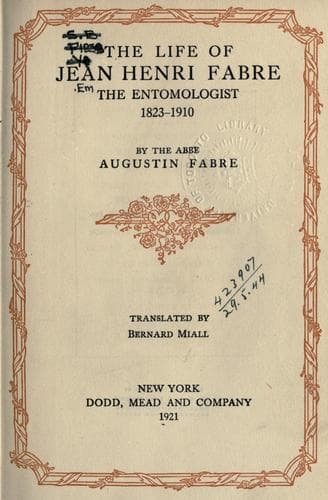
The life of Jean Henri Fabre, the entomologist, 1823-1910Fabre, Augustin
Science
The life of Jean Henri Fabre, the entomologist, 1823-1910
Fabre, Augustin
Entomologists -- France -- Biography; Fabre, Jean-Henri, 1823-1915
The principal of the school, the soul of kindness, has grasped my
passion for knowledge. He encourages me in my determination; he
proposes to make me renew my acquaintance with Horace and Virgil,
so long since forgotten. He knows Latin, he does; he will rekindle
the dead spark by making me translate a few passages. He does more:
he lends me an Imitation, with parallel texts in Latin and Greek.
With the first text, which I am almost able to read, I will puzzle
out the second and thus increase the small vocabulary which I
acquired in the days when I was translating Æsop’s Fables. It will
be all the better for my future studies. What luck! Board and
lodging, ancient poetry, the classical languages, all the good
things at once!
I did better still. Our science-master—the real, not the honorary
one—who came twice a week to discourse of the rule of three and the
properties of the triangle, had the brilliant idea of letting us
celebrate the end of the school year with a feast of learning. He
promised to show us oxygen. As a colleague of the chemist in the
grammar-school, he obtained leave to take us to the famous
laboratory and there to handle the object of his lesson under our
very eyes. Oxygen, yes, oxygen, the all-consuming gas; that was
what we were to see on the morrow. I could not sleep all night for
thinking of it.
Thursday afternoon came at last. As soon as the chemistry lesson
was over, we were to go for a walk to Les Angles, the pretty
village over yonder, perched on a steep rock. We were therefore in
our Sunday best, our out-of-door clothes: black frock-coats and
tall hats. The whole school was there, some thirty of us, in the
charge of an usher, who knew as little as we did of the things
which we were about to see. We crossed the threshold of the
laboratory, not without excitement. I entered a great nave with a
Gothic roof, an old, bare church through which one’s voice echoed,
while the light penetrated discreetly through stained-glass windows
set in ribs and rosettes of stone. At the back were huge raised
benches, with room for an audience of many hundreds; at the other
end, where the choir once was, stood an enormous chimney-mantel; in
the middle was a large massive table, corroded by the chemicals. At
one end of this table was a tarred tub, lined inside with lead and
filled with water. This, I at once learnt, was the pneumatic
trough, the vessel in which the gases were collected.
Public-domain text, read in full here on John Shaqi.
Reviews
Reviews
No reviews yet
Be the first to share your thoughts on this work.
Join the Discussion
Join the discussion
Sign in to leave a comment or review.
Sign InorCreate an account