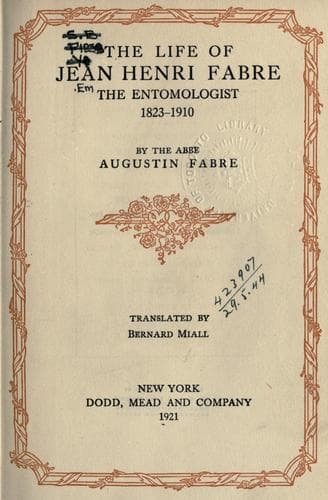
The life of Jean Henri Fabre, the entomologist, 1823-1910Fabre, Augustin
Science
The life of Jean Henri Fabre, the entomologist, 1823-1910
Fabre, Augustin
Entomologists -- France -- Biography; Fabre, Jean-Henri, 1823-1915
The magnificent Bee herself, with her dark-violet wings and
black-velvet raiment, her rustic edifices on the sun-blistered
pebbles amid the thyme, her honey, providing a diversion from the
severities of the compass and the square, all made a great
impression on my mind; and I wanted to know more than I had learnt
from the schoolboys, which was just how to rob the cells of their
honey with a straw. As it happened, my bookseller had a gorgeous
work on insects for sale. It was called Histoire naturelle des
animaux articulés, by de Castelnau, E. Blanchard, and Lucas, and
boasted a multitude of most attractive illustrations; but the price
of it, the price of it! No matter: was not my splendid income
supposed to cover everything, food for the mind as well as food for
the body? Anything extra that I gave to the one I could save upon
the other; a method of balancing painfully familiar to those who
look to science for their livelihood. The purchase was effected.
That day my professional emoluments were severely strained: I
devoted a month’s salary to the acquisition of the book. I had to
resort to miracles of economy for some time to come before making
up the enormous deficit.
The book was devoured; there is no other word for it. In it I
learnt the name of my black Bee; I read for the first time various
details of the habits of insects; I found, surrounded in my eyes
with a sort of halo, the revered names of Réaumur, Huber, and Léon
Dufour; and, while I turned over the pages for the hundredth time,
a voice within me seemed to whisper:
“You also shall be of their company!” [33]
CHAPTER VIII
THE SCHOOLMASTER: CARPENTRAS (CONTINUED)
If he had hearkened only to his tastes, the young schoolmaster of
Carpentras would have devoted to the world of animals all the time that
was not taken up by his pupils. But his profession itself and the
requirements of his future prevented him from following the dominant
attraction unchecked. He had formed a resolve “to raise himself above
the level of the primary school, which at that time barely fed its
teachers,” and to make a place for himself in the ranks of secondary
instruction. He had, therefore, to renounce his natural history, since
that as yet had no place in the curriculum, and he had to take up
mathematics.
So we see him submerged in conic sections and the differential and
integral calculus, without a guide, without advice, confronted for days
on end by some obscure difficulty which tenacious meditation eventually
robbed of its mystery. Mathematics, however, formed only the first part
of his programme, which comprised also physics and chemistry. These, no
doubt, were less abstruse sciences, but the necessary equipment was
also less simple. He needed a laboratory; he could not run to the
expense of one; so he made one, an “impossible” one, by force of
industry.
Public-domain text, read in full here on John Shaqi.
Reviews
Reviews
No reviews yet
Be the first to share your thoughts on this work.
Elsewhere in the archive
Join the Discussion
Join the discussion
Sign in to leave a comment or review.
Sign InorCreate an account