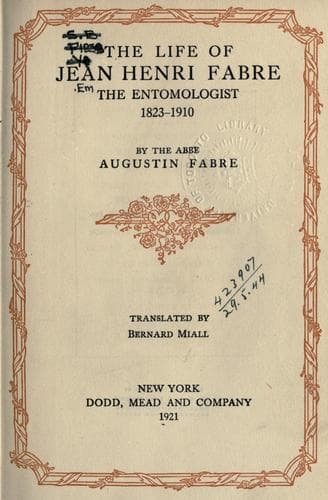
The life of Jean Henri Fabre, the entomologist, 1823-1910Fabre, Augustin
Science
The life of Jean Henri Fabre, the entomologist, 1823-1910
Fabre, Augustin
Entomologists -- France -- Biography; Fabre, Jean-Henri, 1823-1915
And so, when May came, once every week we left the gloomy
schoolroom for the fields. It was a regular holiday. The boys
disputed for the honour of carrying the stakes, divided into
bundles of three; and more than one shoulder, as we walked through
the town, felt the reflected glory of those erudite rods. I
myself—why conceal the fact?—was not without a certain satisfaction
as I piously carried that most delicate and precious apparatus, the
historic five-franc graphometer. The scene of operations was an
untilled, flinty plain, a harmas, as we call it in the district.
Here, no curtain of green hedges or shrubs prevented me from
keeping an eye upon my staff; here—an indispensable condition—I had
not the irresistible temptation of the unripe apricots to fear for
my scholars. The plain stretched far and wide, covered with nothing
but flowering thyme and rounded pebbles. There was ample scope for
every imaginable polygon; trapezes and triangles could be combined
in all sorts of ways. The inaccessible distances had ample
elbow-room; and there was even an old ruin, once a pigeon-house,
that lent its perpendicular to the graphometer’s performances.
These exercises in open-air geometry, which had their charm, discounted
beforehand, had also their delightful surprises and unexpected
consequences which place them among the happiest experiences of the
life which we are describing:
Well, from the very first day, my attention was attracted by
something suspicious. If I sent one of the boys to plant a stake, I
would see him stop frequently on his way, bend down, stand up
again, look about and stoop once more, neglecting his straight line
and his signals. Another, who was told to pick up the arrows, would
forget the iron pin and take up a pebble instead; and a third, deaf
to the measurements of angles, would crumble a clod of earth
between his fingers. Most of them were caught licking a bit of
straw. The polygon came to a full stop, the diagonals suffered.
What could the mystery be?
I inquired; and everything was explained. A born searcher and
observer, the scholar had long known what the master had not yet
heard of, namely, that there was a big black Bee who made clay
nests on the pebbles of the harmas. These nests contained honey;
and my surveyors used to open them and empty the cells with a
straw. The honey, although rather strong-flavoured, was most
acceptable. I acquired a taste for it myself and joined the
nest-hunters, putting off the polygon till later. It was thus that
I first saw Réaumur’s Mason Bee, [32] knowing nothing of her
history and nothing of her historian.
Public-domain text, read in full here on John Shaqi.
Reviews
Reviews
No reviews yet
Be the first to share your thoughts on this work.
Elsewhere in the archive
Join the Discussion
Join the discussion
Sign in to leave a comment or review.
Sign InorCreate an account