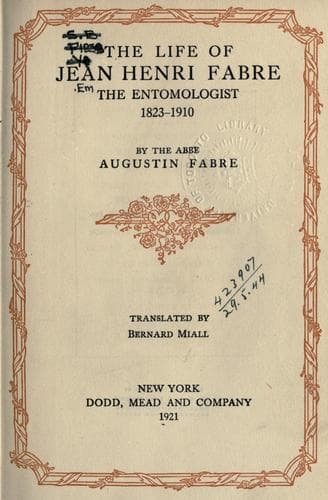
The life of Jean Henri Fabre, the entomologist, 1823-1910Fabre, Augustin
Science
The life of Jean Henri Fabre, the entomologist, 1823-1910
Fabre, Augustin
Entomologists -- France -- Biography; Fabre, Jean-Henri, 1823-1915
Not that he had time to make a very rich harvest of facts and
observations in this wonderful country. The most visible result of his
sojourn in the “isle of beauty,” and the greatest benefit which he
derived from it, seems to have been the fact that it brought his heart
and mind—if I may be permitted the expression—into a state of
entomological grace; I mean into a state of living and acting truly and
beautifully in accordance with his vocation as a naturalist.
So it is that the name of this radiant daughter of the Mediterranean,
which is so often written by his pen, seems to find its way thither in
order to evoke one of the brightest and most joyful periods of his
life, rather than to localise observations or circumstantial
experiences.
There is, however, one of these reminiscences which, despite the
extreme sobriety of the characteristics recorded, denotes, in the
youthful entomologist, a mind peculiarly attentive to the slightest
indications and the least movements of his future clients of the animal
world. It deals with the Spider, [48] that ill-famed creature whom all
hasten to crush underfoot as an odious and maleficent insect, but which
the entomologist holds in high esteem for its talents as a spinner, its
hunting expedients, and other highly interesting characteristics. The
author has just explained, on behalf of the poor, supposedly poisonous
insect, that for us its bite has no serious results, producing less
effect than the bite of a gnat: “Nevertheless, a few are to be feared;
and foremost among these is the Malmignatte, the terror of the Corsican
peasantry.”
By good fortune the only Tarantula that bit him in Corsica was the
Tarantula of natural history.
But while he was not injured by the spiders, he was less fortunate in
defending himself against the mosquitoes, from whose bites he
contracted an attack of malaria, in the myrtle maquis which he
doubtless haunted more persistently than was wise.
This unfortunate incident persuaded him to apply for an appointment in
France.
CHAPTER X
THE PROFESSOR: AVIGNON (1852–1870)
In 1852 the Professor of Physics and Chemistry in the lycée of Ajaccio
was transferred to the lycée of Avignon.
Fabre was not yet twenty-seven. His youth, his enthusiasm, his good
humour, the simplicity of his manners, and the vivacity of his mind
naturally endeared him to young people eager for knowledge and the
ideal. A few lines from the Souvenirs give us some idea of the
relations between master and pupils: “There were five or six of us: I
was the oldest, their master, but still more their companion and their
friend; they were young fellows with warm hearts and cheerful
imaginations, overflowing with that springtide sap of life which makes
us so expansive, so desirous of knowledge.”
One guesses that he is speaking of one of those country walks on which,
with a guide such as Fabre, everything became a source of instruction
and an object of wonder and admiration.
Public-domain text, read in full here on John Shaqi.
Reviews
Reviews
No reviews yet
Be the first to share your thoughts on this work.
Elsewhere in the archive
Join the Discussion
Join the discussion
Sign in to leave a comment or review.
Sign InorCreate an account