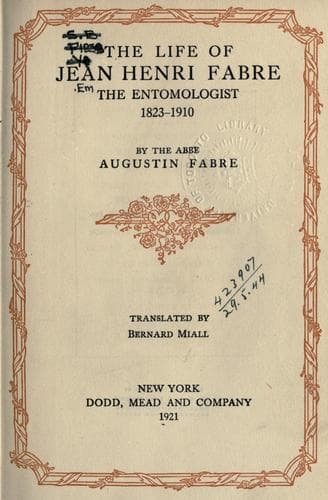
The life of Jean Henri Fabre, the entomologist, 1823-1910Fabre, Augustin
Science
The life of Jean Henri Fabre, the entomologist, 1823-1910
Fabre, Augustin
Entomologists -- France -- Biography; Fabre, Jean-Henri, 1823-1915
This last scene was enacted on one of the deeply-sunken roads on the
outskirts of Carpentras, whither Fabre was fond of repairing for his
researches. From an early period, indeed, his craze for exploration had
led him far beyond the Avignon district. On this third stage of his
excursions, he struck out to some extent in all directions, but the
locality which he preferred for his insect-hunting was undoubtedly the
“Sunken Road,” as it was called, in the neighbourhood of Carpentras. A
lonely valley with a sandy soil, with high, steep slopes on either
hand, its flanks deeply scored into ravines and burned by the sun, the
“Sunken Road” was an ideal home for the Hymenoptera, those lovers of
sunny slopes and soils that are easily worked; and this was enough to
make it the favourite haunt of the intrepid biologist. [54]
Among the Hymenoptera that frequent the slopes and embankments of the
“Sunken Road,” in addition to the Hunting-wasps, which feed their larvæ
on living flesh, there are other species which provide them with honey.
These also attracted the naturalist’s attention; these also provided a
protracted test for his ingenuity and patience, and finally rewarded
his pains beyond all hopes.
The following is an interesting description of the naturalist’s
encounter with a swarm of Bees in the “Sunken Road” while endeavouring
to observe the installation of the Sitares in the cell of the
Anthophora:
In front of a high expanse of earth a swarm stimulated by the sun,
which floods it with light and heat, is dancing a crazy ballet. It
is a hover of Anthophoræ, a few feet thick and covering an area
which matches the sort of house-front formed by the perpendicular
soil. From the tumultuous heart of the cloud rises a monotonous,
threatening murmur, while the bewildered eye strays through the
inextricable evolutions of the eager throng. With the rapidity of a
lightning-flash, thousands of Anthophoræ are incessantly flying off
and scattering over the country-side in search of booty; thousands
of others also are incessantly arriving, laden with honey or
mortar, and keeping up the formidable proportions of the swarm.
I was at that time something of a novice as regards the nature of
these insects.
“Woe,” said I to myself, “woe to the reckless wight bold enough to
enter the heart of this swarm and, above all, to lay a rash hand
upon the dwellings under construction! Forthwith surrounded by the
furious host, he would expiate his rash attempt, stabbed by a
thousand stings!”
At this thought, rendered still more alarming by the recollection
of certain misadventures of which I had been the victim when
seeking to observe too closely the combs of the Hornet (Vespa
crabro), I felt a shiver of apprehension pass through my body.
Public-domain text, read in full here on John Shaqi.
Reviews
Reviews
No reviews yet
Be the first to share your thoughts on this work.
Elsewhere in the archive
Join the Discussion
Join the discussion
Sign in to leave a comment or review.
Sign InorCreate an account