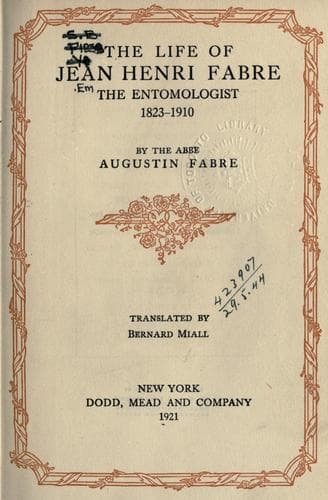
The life of Jean Henri Fabre, the entomologist, 1823-1910Fabre, Augustin
Science
The life of Jean Henri Fabre, the entomologist, 1823-1910
Fabre, Augustin
Entomologists -- France -- Biography; Fabre, Jean-Henri, 1823-1915
But we will pass over the remarks made at breakfast and the incidents
of the last stage of the climb; we will make direct for the summit of
Mont Ventoux, where the leader of the expedition will give us a glimpse
of the delights that await the naturalist at the end of his climb when
he has taken the precaution to make it at the right moment:
Would you do some really fruitful botanising? Be there in the first
fortnight of July; above all, be ahead of the grazing herds: where
the sheep has browsed you will gather none but wretched leavings.
While still spared by the hungry flocks, the top of the Ventoux in
July is a literal bed of flowers; its loose stony surface is
studded with them. My memory recalls, all streaming with the
morning dew, those elegant tufts of Androsace villosa, with its
pink-centred white blooms; the Mont-Cenis violet, spreading its
great blue blossoms over the chips of limestone; the spikenard
valerian, which blends the sweet perfume of its flowers with the
offensive odour of its roots; the wedge-leaved globularia, forming
close carpets of bright green dotted with blue capitula; the Alpine
forget-me-not, whose blue rivals that of the skies; the Candolla
candy-tuft, whose tiny stalk bears a dense head of little white
flowers and goes winding among the loose stones. [63]
Our naturalist is evidently fascinated by so many beauties, of such
delicate quality. Will he not be tempted to forsake his insects for the
flowers? Will not the botanical wealth of the Ventoux make him forget
the entomological wonders of the “Sunken Road”? No; he is saved from
such an error by God and the good genius that watches over the destiny
of him who is to become the prince of entomologists. Even in his
lectures on botanical subjects the insects are given their due; and now
from time to time they claim his attention and seduce him from the
spectacle of the vegetable curiosities which form the principal motive
of the expedition; it is now the Ammophila and now the Decticus [64]
that crosses the path of the naturalist in search of plants and
flowers, recalling, by some of the most curious problems of entomology,
the first beginnings of his vocation and the great task of his life.
But the silent language of the tiny creatures destined to be his most
intimate companions through life was seconded, at an opportune moment,
by the more expressive language of human speech. Here we have one of
those events that were landmarks in Fabre’s life, marking the
starting-point of a fresh phase in the evolution of his ideas and his
labours. He alone can describe for us the actual nature and exact
significance of this incident:
Public-domain text, read in full here on John Shaqi.
Reviews
Reviews
No reviews yet
Be the first to share your thoughts on this work.
Elsewhere in the archive
Join the Discussion
Join the discussion
Sign in to leave a comment or review.
Sign InorCreate an account