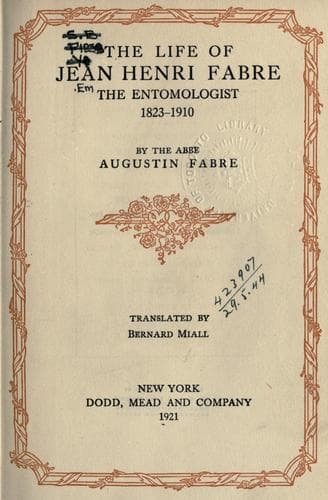
The life of Jean Henri Fabre, the entomologist, 1823-1910Fabre, Augustin
Science
The life of Jean Henri Fabre, the entomologist, 1823-1910
Fabre, Augustin
Entomologists -- France -- Biography; Fabre, Jean-Henri, 1823-1915
Dufour’s little work was a revelation; a flash of light revealing his
vocation. It was like the electric impulse that bursts the seed about
to open, that sends the genius ready to unfold its wings soaring into
the heavens.
It was to the chance perusal of a certain passage that another prince
of science owed the awakening of his genius. We are speaking of
Pasteur, whom we shall presently see in his dealings with Fabre. “It
was through reading a note by the Russian chemist, Mitscherlich, on the
comparison of the specific characters of certain crystals that Pasteur
became interested in those investigations of the subject of molecular
dissymmetry which were the starting-point of so many wonderful
discoveries.” [67]
Does it not seem that there must be a special Providence for the elect
of science?
In Dufour’s memoir, which gave Fabre so decisive an impulsion toward
entomology, a singular fact is mentioned: the naturalist of the Landes
found in the nest of a species of Wasp known as the Cerceris some small
beetles of the Buprestis family, which, although apparently dead,
remained as fresh as though alive during the period occupied by the
rearing of the larvæ for whose nourishment they are destined to serve.
Dufour supposed that these Buprestes were simply dead, and, “in order
to explain this marvellous preservation of their flesh, which makes an
insect that for several weeks has been motionless as a corpse a kind of
game that does not become high but remain as fresh as at the moment of
capture during the greatest heat of summer, he presumed the use of a
liquid antiseptic, acting in the same manner as the preparations used
to preserve anatomical specimens. This liquid could only be the venom
of the Hymenopteron inoculated into the victim’s body. The tiny drop of
poisonous humour that accompanies the sting, the lancet employed in the
inoculation, is supposed to perform the office of a kind of pickle or
preservative liquid for preserving the flesh set aside for the
nourishment of the larvæ.”
But Fabre was burning with curiosity to observe for himself a
phenomenon which an old practitioner like Dufour proclaims the most
curious and extraordinary known to the history of the insect kingdom.
[68] He did not hesitate to go to Carpentras, to search for the
Buprestis-hunting wasp, which does not occur in the neighbourhood of
Avignon. A minute inspection of the Cerceris’ victims enabled him to
prove that, not only was the flesh intact, but the joints were
flexible, the viscera were moist, defalcation persisted, and vestiges
of irritability even were present, all of which facts were scarcely
compatible “with the supposition of an animal absolutely dead, the
hypothesis of a true corpse rendered incorruptible by the effect of a
liquid preservative.” He was thus led to conclude that the insect was
not dead, but only benumbed and reduced to a state of immobility.
Public-domain text, read in full here on John Shaqi.
Reviews
Reviews
No reviews yet
Be the first to share your thoughts on this work.
Elsewhere in the archive
Join the Discussion
Join the discussion
Sign in to leave a comment or review.
Sign InorCreate an account