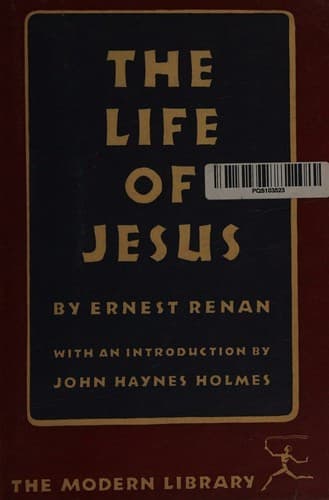
Christian biography -- Palestine; Jesus Christ -- Biography
Sometimes the master, more versed in things of heaven than those of
earth, taught a still more singular political economy. In a strange
parable, a steward is praised for having made himself friends among
the poor at the expense of his master, in order that the poor might in
their turn introduce him into the kingdom of heaven. The poor, in
fact, becoming the dispensers of this kingdom, will only receive those
who have given to them. A prudent man, thinking of the future, ought
therefore to seek to gain their favor. "And the Pharisees also," says
the evangelist, "who were covetous, heard all these things: and they
derided him."[1] Did they also hear the formidable parable which
follows? "There was a certain rich man, which was clothed in purple
and fine linen, and fared sumptuously every day: and there was a
certain beggar named Lazarus, which was laid at his gate, full of
sores, and desiring to be fed with the crumbs which fell from the rich
man's table: moreover the dogs came and licked his sores. And it came
to pass, that the beggar died, and was carried by the angels into
Abraham's bosom: the rich man also died, and was buried;[2] and in
hell he lifted up his eyes, being in torments, and seeth Abraham afar
off, and Lazarus in his bosom. And he cried and said, Father Abraham,
have mercy on me, and send Lazarus that he may dip the tip of his
finger in water, and cool my tongue; for I am tormented in this flame.
But Abraham said, Son, remember that thou in thy lifetime receivedst
thy good things; and likewise Lazarus evil things: but now he is
comforted and thou art tormented."[3] What more just? Afterward this
parable was called that of the "wicked rich man." But it is purely and
simply the parable of the "rich man." He is in hell because he is
rich, because he does not give his wealth to the poor, because he
dines well, while others at his door dine badly. Lastly, in a less
extravagant moment, Jesus does not make it obligatory to sell one's
goods and give them to the poor except as a suggestion toward greater
perfection. But he still makes this terrible declaration: "It is
easier for a camel to go through the eye of a needle than for a rich
man to enter into the kingdom of God."[4]
[Footnote 1: Luke xvi. 1-14.]
[Footnote 2: See the Greek text.]
[Footnote 3: Luke xvi. 19-25. Luke, I am aware, has a very decided
communistic tendency (comp. vi. 20, 21, 25, 26), and I think he has
exaggerated this shade of the teaching of Jesus. But the features of
the [Greek: Logia] of Matthew are sufficiently significant.]
[Footnote 4: Matt. xix. 24; Mark x. 25; Luke xviii. 25. This
proverbial phrase is found in the Talmud (Bab., _Berakoth_, 55 _b_,
_Baba metsia_, 38 _b_) and in the Koran (Sur., vii. 38.) Origen and
the Greek interpreters, ignorant of the Semitic proverb, thought that
it meant a cable ([Greek: kamilos]).]
Public-domain text, read in full here on John Shaqi.
Reviews
Reviews
No reviews yet
Be the first to share your thoughts on this work.
Elsewhere in the archive
Join the Discussion
Join the discussion
Sign in to leave a comment or review.
Sign InorCreate an account