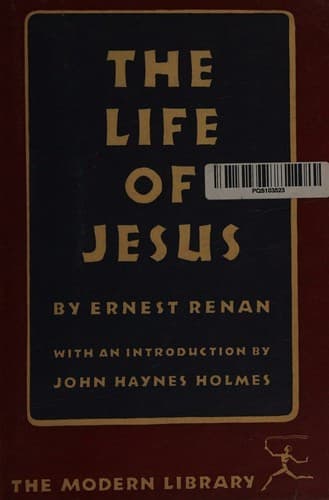
Christian biography -- Palestine; Jesus Christ -- Biography
The prophet Malachi, whose opinion in this matter was soon brought to
bear,[1] had announced with much energy a precursor of the Messiah,
who was to prepare men for the final renovation, a messenger who
should come to make straight the paths before the elected one of God.
This messenger was no other than the prophet Elias, who, according to
a widely spread belief, was soon to descend from heaven, whither he
had been carried, in order to prepare men by repentance for the great
advent, and to reconcile God with his people.[2] Sometimes they
associated with Elias, either the patriarch Enoch, to whom for one or
two centuries they had attributed high sanctity;[3] or Jeremiah,[4]
whom they considered as a sort of protecting genius of the people,
constantly occupied in praying for them before the throne of God.[5]
This idea, that two ancient prophets should rise again in order to
serve as precursors to the Messiah, is discovered in so striking a
form in the doctrine of the Parsees that we feel much inclined to
believe that it comes from that source.[6] However this may be, it
formed at the time of Jesus an integral portion of the Jewish theories
about the Messiah. It was admitted that the appearance of "two
faithful witnesses," clothed in garments of repentance, would be the
preamble of the great drama about to be unfolded, to the astonishment
of the universe.[7]
[Footnote 1: Malachi iii. and iv.; _Ecclesiasticus_ xlviii. 10. See
_ante_, Chap. VI.]
[Footnote 2: Matt. xi. 14, xvii. 10; Mark vi. 15, viii. 28, ix. 10,
and following; Luke ix. 8, 19.]
[Footnote 3: _Ecclesiasticus_ xliv. 16.]
[Footnote 4: Matt. xvi. 14.]
[Footnote 5: 2 _Macc._ v. 13, and following.]
[Footnote 6: Texts cited by Anquetil-Duperron, _Zend-Avesta_, i. 2d
part, p. 46, corrected by Spiegel, in the _Zeitschrift der deutschen
morgenlaendischen Gesellschaft_, i. 261, and following; extracts from
the _Jamasp-Nameh_, in the _Avesta_ of Spiegel, i., p. 34. None of the
Parsee texts, which truly imply the idea of resuscitated prophets and
of precursors, are ancient; but the ideas contained in them appear to
be much anterior to the time of the compilation itself.]
[Footnote 7: _Rev._ xi. 3, and following.]
It will be seen that, with these ideas, Jesus and his disciples could
not hesitate about the mission of John the Baptist. When the scribes
raised the objection that the Messiah could not have come because
Elias had not yet appeared,[1] they replied that Elias was come, that
John was Elias raised from the dead.[2] By his manner of life, by his
opposition to the established political authorities, John in fact
recalled that strange figure in the ancient history of Israel.[3]
Jesus was not silent on the merits and excellencies of his forerunner.
He said that none greater was born among the children of men. He
energetically blamed the Pharisees and the doctors for not having
accepted his baptism, and for not being converted at his voice.[4]
[Footnote 1: Mark ix. 10.]
Public-domain text, read in full here on John Shaqi.
Reviews
Reviews
No reviews yet
Be the first to share your thoughts on this work.
Elsewhere in the archive
Join the Discussion
Join the discussion
Sign in to leave a comment or review.
Sign InorCreate an account