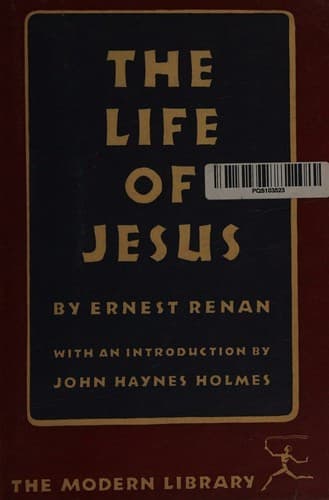
Christian biography -- Palestine; Jesus Christ -- Biography
The day on which he uttered this saying, he was truly Son of God. He
pronounced for the first time the sentence upon which will repose the
edifice of eternal religion. He founded the pure worship, of all ages,
of all lands, that which all elevated souls will practice until the
end of time. Not only was his religion on this day the best religion
of humanity, it was the absolute religion; and if other planets have
inhabitants gifted with reason and morality, their religion cannot be
different from that which Jesus proclaimed near the well of Jacob. Man
has not been able to maintain this position: for the ideal is realized
but transitorily. This sentence of Jesus has been a brilliant light
amidst gross darkness; it has required eighteen hundred years for the
eyes of mankind (what do I say! for an infinitely small portion of
mankind) to become accustomed to it. But the light will become the
full day, and, after having run through all the cycles of error,
mankind will return to this sentence, as the immortal expression of
its faith and its hope.
CHAPTER XV.
COMMENCEMENT OF THE LEGENDS CONCERNING JESUS--HIS OWN IDEA OF HIS
SUPERNATURAL CHARACTER.
Jesus returned to Galilee, having completely lost his Jewish faith,
and filled with revolutionary ardor. His ideas are now expressed with
perfect clearness. The innocent aphorisms of the first part of his
prophetic career, in part borrowed from the Jewish rabbis anterior to
him, and the beautiful moral precepts of his second period, are
exchanged for a decided policy. The Law would be abolished; and it was
to be abolished by him.[1] The Messiah had come, and he was the
Messiah. The kingdom of God was about to be revealed; and it was he
who would reveal it. He knew well that he would be the victim of his
boldness; but the kingdom of God could not be conquered without
violence; it was by crises and commotions that it was to be
established.[2] The Son of man would reappear in glory, accompanied by
legions of angels, and those who had rejected him would be confounded.
[Footnote 1: The hesitancy of the immediate disciples of Jesus, of
whom a considerable portion remained attached to Judaism, might cause
objections to be raised to this. But the trial of Jesus leaves no room
for doubt. We shall see that he was there treated as a "corrupter."
The Talmud gives the procedure adopted against him as an example of
that which ought to be followed against "corrupters," who seek to
overturn the Law of Moses. (Talm. of Jerus., _Sanhedrim_, xiv. 16;
Talm. of Bab., _Sanhedrim_, 43 _a_, 67 _a_.)]
[Footnote 2: Matt. xi. 12; Luke xvi. 16.]
The boldness of such a conception ought not to surprise us. Long
before this, Jesus had regarded his relation to God as that of a son
to his father. That which in others would be an insupportable pride,
ought not in him to be regarded as presumption.
Public-domain text, read in full here on John Shaqi.
Reviews
Reviews
No reviews yet
Be the first to share your thoughts on this work.
Elsewhere in the archive
Join the Discussion
Join the discussion
Sign in to leave a comment or review.
Sign InorCreate an account