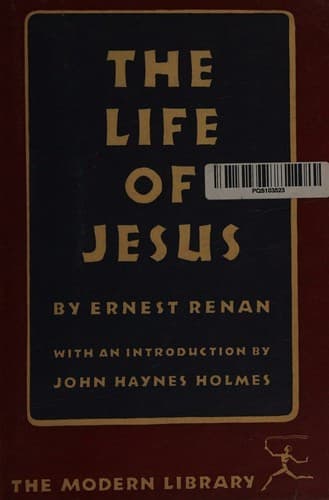
Christian biography -- Palestine; Jesus Christ -- Biography
One great difficulty presented itself--his birth at Nazareth, which
was of public notoriety. We do not know whether Jesus strove against
this objection. Perhaps it did not present itself in Galilee, where
the idea that the son of David should be a Bethlehemite was less
spread. To the Galilean idealist, moreover, the title of "son of
David" was sufficiently justified, if he to whom it was given revived
the glory of his race, and brought back the great days of Israel. Did
Jesus authorize by his silence the fictitious genealogies which his
partisans invented in order to prove his royal descent?[1] Did he know
anything of the legends invented to prove that he was born at
Bethlehem; and particularly of the attempt to connect his Bethlehemite
origin with the census which had taken place by order of the imperial
legate, Quirinus?[2] We know not. The inexactitude and the
contradictions of the genealogies[3] lead to the belief that they
were the result of popular ideas operating at various points, and that
none of them were sanctioned by Jesus.[4] Never does he designate
himself as son of David. His disciples, much less enlightened than he,
frequently magnified that which he said of himself; but, as a rule, he
had no knowledge of these exaggerations. Let us add, that during the
first three centuries, considerable portions of Christendom[5]
obstinately denied the royal descent of Jesus and the authenticity of
the genealogies.
[Footnote 1: Matt. i. 1, and following; Luke iii. 23, and following.]
[Footnote 2: Matt. ii. 1, and following; Luke ii. 1, and following.]
[Footnote 3: The two genealogies are quite contradictory, and do not
agree with the lists of the Old Testament. The narrative of Luke on
the census of Quirinus implies an anachronism. See ante, p. 81, note
4. It is natural to suppose, besides, that the legend may have laid
hold of this circumstance. The census made a great impression on the
Jews, overturned their narrow ideas, and was remembered by them for a
long period. Cf. _Acts_ v. 37.]
[Footnote 4: Julius Africanus (in Eusebius, _H.E._, i. 7) supposes
that it was the relations of Jesus, who, having taken refuge in
Batanea, attempted to recompose the genealogies.]
[Footnote 5: The _Ebionites_, the "Hebrews," the "Nazarenes," Tatian,
Marcion. Cf. Epiph., _Adv. Haer._, xxix. 9, xxx. 3, 14, xlvi. 1;
Theodoret, _Haeret. fab._, i. 20; Isidore of Pelusium, Epist. i. 371,
ad Pansophium.]
Public-domain text, read in full here on John Shaqi.
Reviews
Reviews
No reviews yet
Be the first to share your thoughts on this work.
Elsewhere in the archive
Join the Discussion
Join the discussion
Sign in to leave a comment or review.
Sign InorCreate an account